NON-CLASSICAL LIE SYMMETRY ANALYSIS OF KDV, JAULENT–MIODEK, AND JIMBO–MIWA EQUATIONS
DOI:
https://doi.org/10.71146/kjmr917Keywords:
Non-classical Lie symmetry, invariant solutions, KdV equation, Jaulent–Miodek equation, Jimbo–Miwa equation, symmetry reductionAbstract
The Lie symmetry analysis of non-classical is presented in the context of three important nonlinear partial differential equations, the (1+1)-dimensional Kortewegde Vries (KdV) equation, the (1+2)-dimensional Jaulent-Miodek (JM) equation and the (1+3)-dimensional modified Jimbo-Miwa equation. The non-classical symmetry approach, a variation on the classical Lie symmetry analysis, by adding an invariant surface condition, is employed to achieve symmetry reductions and invariant solutions of these equations. The corresponding determining equations are obtained and solved to construct non-classical symmetry generators. These generators are subsequently used to elicit smaller forms and even exact solutions to the invariance.
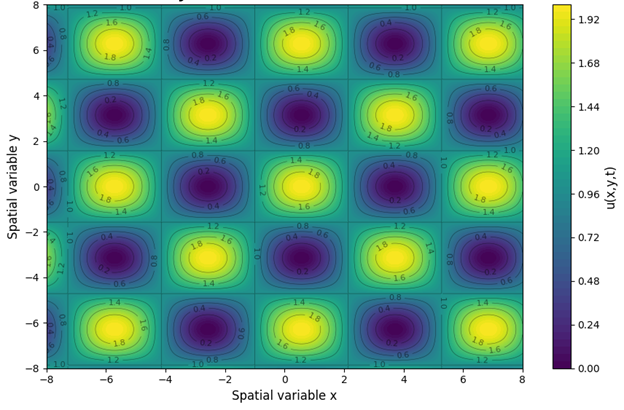
The results of the analysis are subsequently validated and interpreted by visualizing representative solutions through contour plots, surface plots and line profiles. Graphical Analysis the KdV equation forms localised travelling wave structures, the JM equation gives periodic wave structures in two space dimensions and the modified Jimbo-Miwa equation, demonstrates complex multidimensional interactions of waves. The findings underscore how the non-classical symmetry approach can be efficiently used to find physically significant solutions, especially to higher-dimensional nonlinear PDEs. The study extends the already existing literature on non-classical symmetry analysis to the multidimensional models and provides both analytical and graphical understanding of the behaviour of the solutions involving the multidimensional models.
Downloads
References
[1] W. E. Boyce and R. C. DiPrima, Elementary Differential Equations, NJ: Wiley, 2017.
[2] D. G. Zill, A First Course in Differential Equations with Modeling Applications, Boston: Cengage Learning, 2012.
[3] N. Khalid, M. Abbas, M. K. Iqbal and D. Baleanu, " A numerical algorithm based on modified extended B-spline functions for solving time-fractional diffusion wave equation involving reaction and damping terms.," Advances in Difference Equations, p. 378, 03 September 2019.
[4] . F. Schwarz, "Symmetries of Differential Equations: From Sophus Lie to Computer Algebra," SIAM Review, vol. 30, no. 3, pp. 450-481, 1988.
[5] G. W. Bluman and S. Kumei, ymmetries and Differential Equations, New York: Springer, 1989.
[6] P. J. Olver, "Direct reduction and differential constraints," Proceedings of the Royal Society of London. Series A: Mathematical and Physical Sciences, vol. 444, no. 1922, pp. 509-523, 1994.
[7] S. Y. Lou, X. Y. Tang and J. Lin, "Similarity and conditional similarity reductions of a (2+1)-dimensional KdV equation via a direct method," Journal of Mathematical Physics, vol. 41, no. 12, pp. 8286-8303, 2000.
[8] F. Schwarz, "Symmetries of differential equations: from Sophus Lie to computer algebra," SIAM Review, vol. 30, no. 3, pp. 450-481, 1988.
[9] P. J. Olver and P. Rosenau, "The construction of special solutions to partial differential equations," Physics Letters A, vol. 114, no. 3, pp. 107-112, 1986.
[10] O. J. Olver and P. Rosenau, "Group-invariant solutions of differential equations," SIAM Journal on Applied Mathematics, vol. 47, no. 2, pp. 263-278, 1987.
[11] J. R. King, "Exact similarity solutions to some nonlinear diffusion equations," Journal of Physics A: Mathematical and General, vol. 23, no. 16, p. 3681, 1990.
[12] E. Pucci and G. Saccomandi, "On the weak symmetry groups of partial differential equations," Journal of mathematical analysis and applications, vol. 163, no. 2, pp. 588-598, 1992.
[13] W. Hereman, "Review of symbolic software for the computation of Lie symmetries of differential equations," Euromath Bull, vol. 1, no. 2, pp. 45-82, 1994.
Downloads
Published
License
Copyright (c) 2026 Nauman Khalid, Rakshanda Nawaz, Rabia Akhtar (Author)

This work is licensed under a Creative Commons Attribution 4.0 International License.
How to Cite