APPLICATION OF THE BOSANQUET APPROXIMATION FOR MODELING MOISTURE TRANSPORT IN POROUS HUMIDITY SENSORS
DOI:
https://doi.org/10.71146/kjmr913Keywords:
Bosanquet Approximation, Humidity Sensors, Knudsen Diffusion, Molecular Diffusion, Moisture Transport, Porous Materials, Dielectric SensorsAbstract
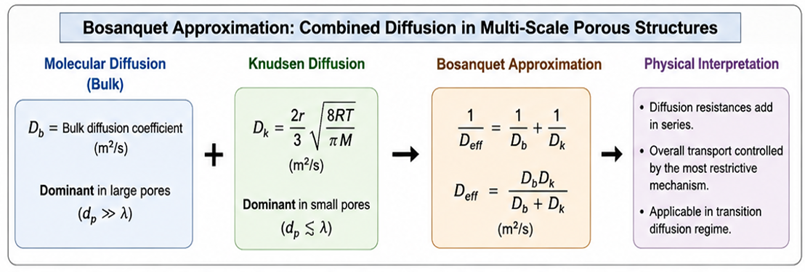
Water vapor transport properties in porous dielectric structures are significantly influencing the performances of porous humidity sensors. Knowledge of diffusion paths that control the movement of moisture will be crucial in developing faster sensor response, sensitivity, and long-term stability. In porous materials, moisture transport is via a combination of bulk molecular transport and Knudsen transport depending on the ratio of pore size to the mean free path of water molecules. Multi-scale porous structures that require both diffusion and transport are often best described using traditional diffusion models. The Bosanquet approximation is a convenient method for including molecular and Knudsen diffusion together in a single effective diffusion coefficient. In this paper, a complete theoretical review of the Bosanquet approximation and moisture transport modelling in porous humidity sensors using the Bosanquet approximation is presented. The fundamentals of molecular diffusion and Knudsen diffusion are described and the Bosanquet equation is derived and discussed with respect to the applicability of the equation in the transition diffusion regimes. Theoretical calculations show the effect of the pore size on the diffusion behavior and the performance of the sensor. The review sets the basis for the current Bosanquet approximation, which is a useful analysis tool for moisture transfer through state-of-the-art porous dielectric materials, and for future coupled diffusion–adsorption modeling methods.
Downloads
References
[1] Krishna, Rajamani, and Jasper M. van Baten. "Investigating the validity of the Bosanquet formula for estimation of diffusivities in mesopores." Chemical engineering science 69, no. 1 (2012): 684-688.
[2] Chen, Qu, and Jianping Zhou. "Investigating the validity of the Bosanquet equation for predicting the self-diffusivities of fluids inside nanotubes using equilibrium molecular dynamics simulations." Aip Advances 13, no. 2 (2023).
[3] Bhatia, Suresh K., and David Nicholson. "Some pitfalls in the use of the Knudsen equation in modelling diffusion in nanoporous materials." Chemical engineering science 66, no. 3 (2011): 284-293.
[4] Kim, Changjae, Hochang Jang, and Jeonghwan Lee. "Experimental investigation on the characteristics of gas diffusion in shale gas reservoir using porosity and permeability of nanopore scale." Journal of Petroleum Science and Engineering 133 (2015): 226-237.
[5] Bosanquet, R. H. M. "XL. On the calculation of the illuminating-power of hydrocarbons and their mixtures.—Part II. Diluents, and general second approximation." The London, Edinburgh, and Dublin Philosophical Magazine and Journal of Science 34, no. 209 (1892): 355-371.
[6] W. Sweet, "Bernard Bosanquet," in *The Stanford Encyclopedia of Philosophy*, E. N. Zalta, Ed. Stanford, CA: Metaphysics Research Lab, Stanford University, 1997.
[7] R. Ziel, A. Haus, and A. Tulke, "Quantification of the Pore Size Distribution (Porosity Profiles) in Microfiltration Membranes by SEM, TEM and Computer Image Analysis," *Journal of Membrane Science*, vol. 323, no. 2, pp. 241–246, 2008.
[8] M. Lawrence and Y. Jiang, "Porosity, Pore Size Distribution, Micro-structure," in *Bio-aggregates Based Building Materials*, S. Amziane and F. Collet, Eds. Dordrecht: Springer, 2017, ch. 2, pp. 39–71.
[9] Ali, Ronak, "SURFACE MORPHOLOGY AND MOISTURE ADSORPTION/ DESORPTION CHARACTERISTICS OF HYBRID-DIELECTRIC MOISTURE SENSORS" (2025). Theses and Dissertations--Electrical and Computer Engineering. 217. https://uknowledge.uky.edu/ece_etds/217, DOI:10.13023/etd.2025.279.
[10] Ronak Ali, Aaron Swartz, Riasad Azim Badhan, Reza Ilka, Yiju Wang, Jiangbiao He, Zhi Chen, Ning Ren, Z George Zhang, Gefei Wu, and Roger England, “Porous Dielectric Structure and Response Speed of Moisture Sensors”, Electrochemical Society (ECS) Transactions, Volume 113, Number 2, DOI: 10.1149/11302.0003ecst.
[11] Ali, Ronak, Aaron Swartz, Riasad Azim Badhan, Zhi David Chen, Reza Ilka, Yiju Wang, JiangBiao He et al. "Effect of surface morphology on the response speed of moisture sensors." Journal of The Electrochemical Society 171, no. 10 (2024): 107512.
[12] Ronak Ali, Riasad Azim Badhan, Jiaming Cai, James Jieming Chen, Zhi David Chen and Chaoyuan Mary Liu, “Moisture Adsorption and Desorption Characteristics for a Hybrid-Dielectric Moisture Sensor”, the Electrochemical Society (ECS) Meeting Abstracts, Volume MA2025-01, M01: Recent Advances in Sensors Systems: General Session, DOI: 10.1149/MA2025-01592825mtgabs, 247th ECS Meeting May 17-22, 2025, Montreal, Canada.
[13] Riasad Azim Badhan, Aaron Swartz, Ronak Ali, James Jieming Chen, Zhi David Chen, Chaoyuan Mary Liu, Jiangbiao He, Ning Ren, Z George Zhang, Gefei Wu and Roger England, “A Sensor System for Trace Moisture Measurement in Oils and Lubricants”, the Electrochemical Society (ECS) Meeting Abstracts, Volume MA2025-01, M01: Recent Advances in Sensors Systems: General Session, DOI: 10.1149/MA2025-01592824mtgabs, 247th ECS Meeting May 17-22, 2025, Montreal, Canada.
[14] Ronak Ali, Aaron Swartz, Riasad Azim Badhan, Reza Ilka, Yiju Wang, Jiangbiao He, Zhi Chen, Ning Ren, Z George Zhang, Gefei Wu, and Roger England, “Surface Morphology and Response Speed of Moisture Sensors”, NNCI Nano + Additive Manufacturing Summit, July 30-31, 2024, University of Louisville, Louisville, Kentucky, the United States of America.
[15] Ronak Ali, Aaron Swartz, Riasad Azim Badhan, Reza Ilka, Yiju Wang, Jiangbiao He, Zhi Chen, Ning Ren, Z George Zhang, Gefei Wu, and Roger England, “Porous Dielectric Structure and Response Speed of Moisture Sensors”, 245th ECS (Electrochemical Society) Meeting, May 26-30, 2024, San Francisco, California, the United States of America.
[16] Zhi David Chen, and Ronak Ali, “High-Performance Humidity Sensor Capable for Monitoring Low-Moisture Levels in Energy Industries”, 245th ECS (Electrochemical Society) Meeting, May 26-30, 2024, San Francisco, California, the United States of America.
[17] Ronak Ali and Zhi David Chen, “Varying Current Effect on Small Pores Inside Large Pores by Anodic Spark Deposition”, 8th Nano Today Conference, April 22-25, 2023, Paradise Point, San Diego, California, the United States of America.
[18] Ronak Ali and Zhi David Chen, “Investigation of Sensing Mechanism of Low Humidity Sensors”, 8th Nano Today Conference, April 22-25, 2023, Paradise Point, San Diego, California, the United States of America.
[19] Ronak Ali, Zhi David Chen, “Coverage of Small Pores with Sputtered Aluminum to Analyze Response Speed of Humidity Sensors”, NNCI Nano and Additive Manufacturing Summit July 25-26, 2023, held at University of Louisville, Louisville, Kentucky, the United States of America.
Downloads
Published
Issue
Section
Categories
License
Copyright (c) 2026 Ronak Ali, Abdul Qadir Rahimoon, Safdar Ali Abro, Muneer Abbas, Madad Ali Shah (Author)

This work is licensed under a Creative Commons Attribution 4.0 International License.
How to Cite