THE IMPACT OF INFORMATION TECHNOLOGY ON ENHANCING PUBLIC SECTOR SERVICES IN PAKISTAN: AN EMPIRICAL ANALYSIS
DOI:
https://doi.org/10.71146/kjmr912Keywords:
Information Technology, E-Government, Public Sector, Pakistan, Digital Transformation, Service QualityAbstract
Purpose: Information Technology (IT) application within the public sector has brought some revolution to the delivery of public services in the world particularly with the emergence of e-government and digital government projects. In developing countries like Pakistan, IT is becoming a significant facilitator to improve efficiency, transparency, accessibility, and accountability in service delivery. This study examines how IT has helped in enhancing the service delivery in the public sector in Pakistan, by empirically evaluating the impact that IT has on the efficiency of the public sector, transparency, accessibility and citizen satisfaction.
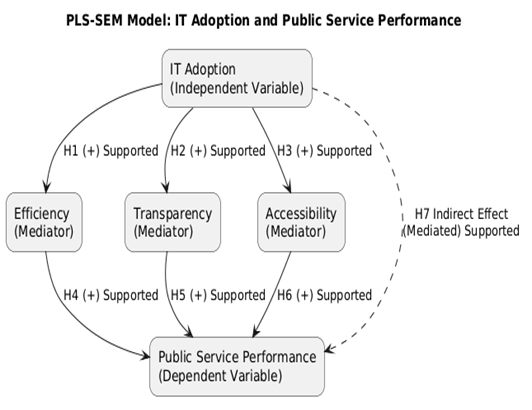
Methodology: This paper has used quantitative research design where the main data was gathered in a sample of 200; divided into employees of the public sector and active users of electronic government services (citizens). The questionnaire employed by the researchers had a 5-point Likert scale. The researchers test the hypotheses and evaluate the direct and indirect effects using Structural Equation Modeling (SEM) and Partial Least Squares (PLS-SEM) (Hair, J. F., Hult, G. T. M., Ringle, C. M., Sarstedt, M., Danks, N. P., & Ray, S. 2021).
Findings: The findings of the study indicate that IT utilization has a positive effect on efficiency, transparency and accessibility of organizations in the public sector. This in its turn improves the services of the government and satisfaction by its citizens. However, the research also shows that there are still some challenges, including the absence of digital infrastructure, digital divide in urban and rural regions, and the problem of cybersecurity and privacy of data.
Implications: This study contributes to the existing body of knowledge on digital governance and information systems, by providing empirical evidence based on a developing nation lens, in this case, Pakistan. It also carries practical implications to policymakers, in the sense that it recommends more investment on the digital infrastructure, capacity building and cybersecurity systems to facilitate the successful implementation of e-government systems.
Downloads
References
Ahmad, N. R. (2025). Digital transformation and competitive advantage: Leveraging AI in emerging market supply chains. Journal of Emerging Technologies and Supply Chain Management, 4(1), 72–86.
Ahmad, N. R. (2025). The impact of fintech startups on financial innovation and stability in Pakistan’s evolving financial landscape. Pakistan Journal of Financial Innovation and Technology, 3(2), 91–105.
Ahmad, N. R. (2026). AI-enabled public governance in developing states: Service delivery gains, accountability risks, and a practical risk based regulatory model. Lex Localis, 24(S1), 99-117.
Akhtar, A. R., Murtaza, G., & Luqman, M. (2025). Technological Innovation in Public Service Delivery: Performance and Uptake of OPGRS in the Landscape of Digital Governance. In Digital Transformation and Sustainability: Methods and Applications (pp. 375-409). Cham: Springer Nature Switzerland.
Alford, S., & Teater, B. (2025). Quantitative research. In Handbook of research methods in social work (pp. 156-171). Edward Elgar Publishing.
Ali, A., Khattak, M. S., Arfeen, M. I., Yousaf, L., & Chaudhary, M. A. I. (2022). Exploration of information technology governance practices in the public sector: a developing country’s perspective. International Journal of Computer Science and Network Security, 22(1), 523-529.
Arshad, A. (2025). Role of Technology Integration in Enhancing Public Sector Governance and Service Delivery in Pakistan. Capital Mark Journal of Marketing & Finance, 1(2), 39-45.
Asimakopoulos, G., Antonopoulou, H., Giotopoulos, K., & Halkiopoulos, C. (2025). Impact of information and communication technologies on democratic processes and citizen participation. Societies, 15(2), 40.
Asmawanti-S, D., Afiah, N. N., Ritchi, H., & Suharman, H. (2025). Literature review of government digital services based on public value theory and citizen perspectives. Cogent Business & Management, 12(1), 2518494.
Djatmiko, G. H., Sinaga, O., & Pawirosumarto, S. (2025). Digital transformation and social inclusion in public services: A qualitative analysis of e-government adoption for marginalized communities in sustainable governance. Sustainability, 17(7), 2908.
Hamdy, A., Diab, A., & Eissa, A. M. (2025). Digital transformation and the quality of accounting information systems in the public sector: Evidence from developing countries. International Journal of Financial Studies, 13(1), 30.
Hamdy, A., Diab, A., & Eissa, A. M. (2025). Digital transformation and the quality of accounting information systems in the public sector: Evidence from developing countries. International Journal of Financial Studies, 13(1), 30.
Imran, M., Robina Ramírez, R., & Awais, H. M. (2022). Empirical investigation of public service performance improvement factors. Polish Journal of Management Studies, 26.
Lim, W. M. (2025). What is quantitative research? An overview and guidelines. Australasian Marketing Journal, 33(3), 325-348.
Munir, M. S., Saud, I., Mubeen, N., Anjum, N., & Ahmad, G. (2025). TRANSFORMING GOVERNMENT SERVICE DELIVERY THROUGH ARTIFICIAL INTELLIGENCE. Spectrum of Engineering Sciences, 3(12), 1313-1327.
Munir, S., & Hamid, M. (2026). E-Government & the Concept of Evidence Based Monitoring for Effective Governance: A Case of Punjab, Pakistan. Public Organization Review, 1-42.
Omer, R. (2025). Advancing Digital Pakistan: A Strategic Review of Current Progress and Global Best Practices. UCP Journal of Humanities & Social Sciences, 4(1), 43-63.
Rani, P., Siddiqui, M. B., Hisbani, F., & Maree, D. A. (2025). Human Potential through Artificial Intelligence to Increase Workforce Productivity. Journal of Management & Social Science, 2(5), 674-690.
Robles, P., & Mallinson, D. J. (2025). Artificial intelligence technology, public trust, and effective governance. Review of policy research, 42(1), 11-28.
Sharmin, S., & Chowdhury, R. H. (2025). Digital transformation in governance: The impact of e-governance on public administration and transparency. Journal of Computer Science and Technology Studies, 7(1), 362-379.
Taeihagh, A. (2025). Governance of generative AI. Policy and society, 44(1), 1-22.
Tasleem, Z., & Muhammad, S. A. (2025). Technological Advancements in Public Services: A Systematic Review. Policy Journal of Social Science Review, 3(12), 390-405.
Wirata, G., Gunawan, M. S., Judijanto, L., Sarmento, A. D. A., & Permono, A. R. (2025). The Role of E-Government Innovation in Enhancing Public Service Performance and Strengthening Transparent Governance. International Journal of Accounting and Economics Studies, 12(6), 710-717.
Downloads
Published
Issue
Section
Categories
License
Copyright (c) 2026 Arslan Zamir, Kashif Ali, Muhammad Azeem, Zahid Khurshid (Author)

This work is licensed under a Creative Commons Attribution 4.0 International License.
How to Cite