ROLE OF TRUST AND TECHNOLOGICAL SELF-EFFICACY IN E-GOVERNMENT PORTALS ADOPTION IN PAKISTAN
DOI:
https://doi.org/10.71146/kjmr902Keywords:
E-government, e-government portals, e-government portals adoption, perceived trust, technological self-efficacy, behavioral intentions to use e-governmentAbstract
ABSTRACT
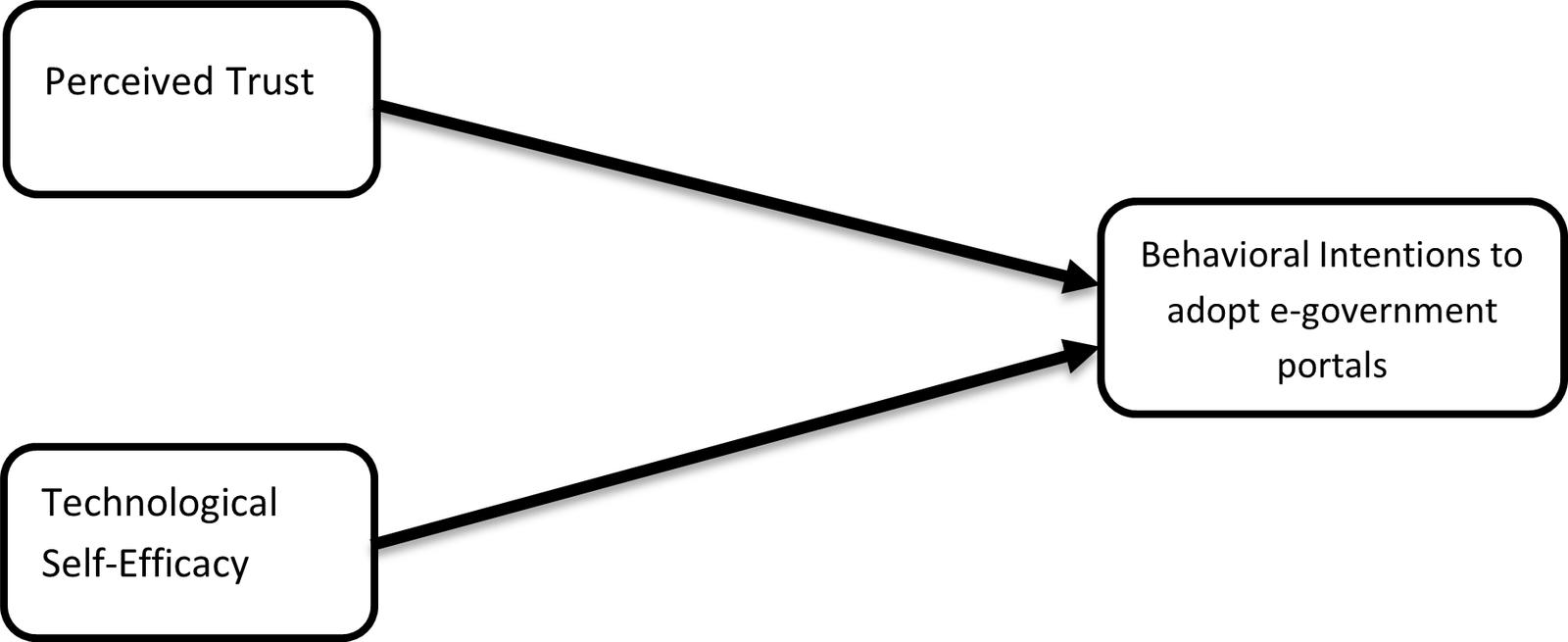
Developing countries are implementing e-government systems; yet, the utilization pattern remains unclear. The ultimate aim of this study was to investigate the impact of perceived trust and technological self-efficacy on citizens adoption of e-government portals in Pakistan. The study used a quantitative cross-sectional technique, with a 5-point Likert scale questionnaire survey to acquire the perception of 345 residents from the urban areas of Sindh, Pakistan. Participants were chosen based on their familiarity with e-government portals, relevance, and convenience. The results show that behavioral intentions to use e-government portals are positively and significantly impacted by the Perceived Trust (β=0.270, p > 0.05), and Technological Self-Efficacy (β=0.227, p > 0.05). The study recommends initiating training workshops, awareness campaigns, and digital literacy programs to raise citizens’ technological self-efficacy and measures for strong data protection, secure login systems, and transparent data usage policies to increase trust level for e-government portals adoption in Pakistan.
Downloads
References
Ahmed, J., Chandio, F. H., & Malkani, Y. A. (2023). Investigating User Acceptance of Blended Learning at University Level: A Cross-Sectional Study. International Journal of Distance Education and E-Learning (IJDEEL), 9(1), 47–65.
Arfat, Y., Rahman, C. A., Rahman, M., & Mahmood, K. (2018). PERCEIVED USEFULNESS OF E-GOVERNMENT AND COMPUTER SELF-EFFICACY TO IMPROVE CONTINUOUS INTENTION TO USE E-GOVERNMENT SERVICES. PAKISTAN BUSINESS REVIEW, 20(1), 174–183.
Dillman, D. A., & Smyth, J. D. (2007). Design Effects in the Transition to Web-Based Surveys. American Journal of Preventive Medicine, 32(5), S90–S96. https://doi.org/10.1016/j.amepre.2007.03.008
Gkikas, D. C., Tzavella, G., Tzioli, M., Vlachopoulou, G., Kondili, I., & Magni Salis, I. (2022). Assessment of E-Government Portals. International Journal of Information Systems in the Service Sector, 14(1), 1–16. https://doi.org/10.4018/IJISSS.287582
Havi, M., Mirjat, S. A., Mirjat, S. A., & Ahmed, J. (2026). Determinants of E-Government Portal Adoption in Pakistan: Evidence from Diffusion of Innovations Theory. The Asian Bulletin of Big Data Management, 6(1), 33–44. https://doi.org/10.62019/8mejmg23
Malhotra, N. K., Kim, S. S., & Patil, A. (2006). Common Method Variance in IS Research: A Comparison of Alternative Approaches and a Reanalysis of Past Research. Management Science, 52(12), 1865–1883. https://doi.org/10.1287/mnsc.1060.0597
Mazhar, A., Iradat, F., Taşkın, N., & Metin, B. (2025). Digital trust and the adoption of e-government services in Pakistan: a systematic literature review. Security Journal, 38(1), 58. https://doi.org/10.1057/s41284-025-00506-z
McDonald, T., & Siegall, M. (1992). The Effects of Technological Self-Efficacy and Job Focus on Job Performance, Attitudes, and Withdrawal Behaviors. The Journal of Psychology, 126(5), 465–475. https://doi.org/10.1080/00223980.1992.10543380
Mustonen‐Ollila, E., & Lyytinen, K. (2003). Why organizations adopt information system process innovations: a longitudinal study using Diffusion of Innovation theory. Information Systems Journal, 13(3), 275–297. https://doi.org/10.1046/j.1365-2575.2003.00141.x
Rana, N. P., Dwivedi, Y. K., & Williams, M. D. (2015). A meta-analysis of existing research on citizen adoption of e-government. Information Systems Frontiers, 17(3), 547–563. https://doi.org/10.1007/s10796-013-9431-z
Rana, N. P., Dwivedi, Y. K., Williams, M. D., & Weerakkody, V. (2015). Investigating success of an e-government initiative: Validation of an integrated IS success model. Information Systems Frontiers, 17(1), 127–142. https://doi.org/10.1007/s10796-014-9504-7
Ranaweera, H. M. B. P. (2016). Perspective of trust towards e-government initiatives in Sri Lanka. Springer Plus, 5(1), 22. https://doi.org/10.1186/s40064-015-1650-y
References: A-priori Sample Size for Structural Equation Models. (n.d.). Free Statistics Calculators. Retrieved April 22, 2026, from https://www.danielsoper.com/statcalc/references.aspx?id=89
Robertson, T. S. (1967). The Process of Innovation and the Diffusion of Innovation. Journal of Marketing, 31(1), 14. https://doi.org/10.2307/1249295
Top Government Websites in Pakistan. (2026). SEMRUSH. https://www.semrush.com/trending-websites/pk/government
Downloads
Published
Issue
Section
Categories
License
Copyright (c) 2026 Moomal Havi, Afia Bhutto, Poonam Bai, Jamil Ahmed (Author)

This work is licensed under a Creative Commons Attribution 4.0 International License.
How to Cite