TELEMETRY PRIMACY UNDER REGIME SHIFT: A CONTROLLED BENCHMARK OF COMMUNICATION-DEGRADATION EARLY WARNING FOR AUTONOMOUS AERIAL LINKS
DOI:
https://doi.org/10.71146/kjmr899Keywords:
Communication Degradation Early Warning, Regime Shift, Aggregate Telemetry Baselines, Hybrid Stacking, Autonomous Aerial LinksAbstract
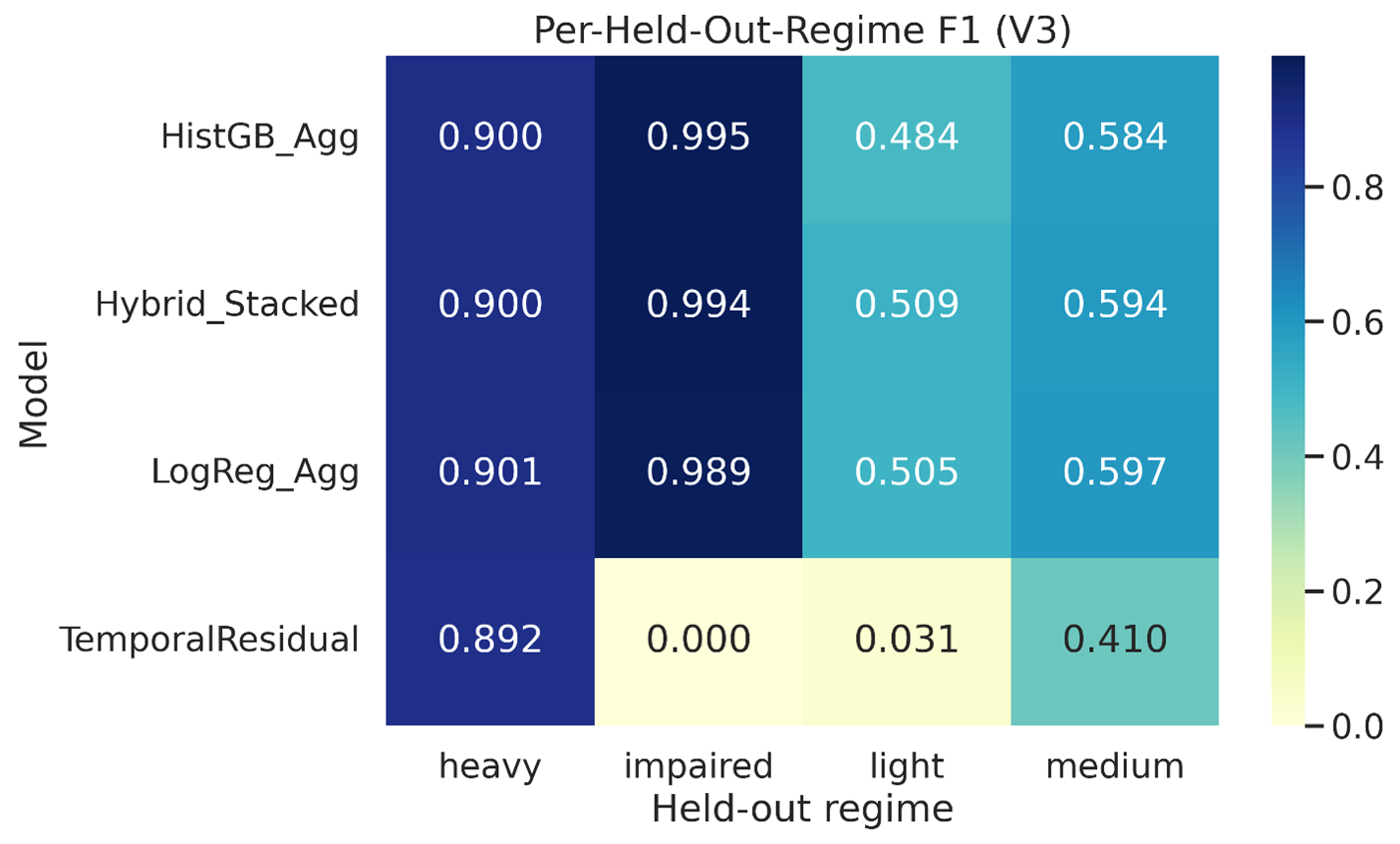
Autonomous aerial systems rely on stable wireless links for control, telemetry exchange, and mission continuity. In practice, these links can degrade under changing load, interference, and difficult operating conditions, which makes early warning important. This paper studies communication-degradation early warning using a controlled 6G telemetry benchmark, while treating UAV-assisted and autonomous aerial links as the motivating application rather than as a direct data source. We formulate the task as next-interval risk prediction from recent telemetry and client-profile information, and evaluate generalization with a leave-one-regime-out protocol across four operating regimes. To test whether added temporal complexity is truly useful, we compare strong aggregate baselines with temporal and hybrid models. The results show that simple aggregate telemetry models remain the strongest overall. In particular, the logistic-regression aggregate baseline provides the strongest overall trade-off, reaching a mean AUROC of 0.876 and a mean balanced accuracy of 0.691 under regime shift. Hybrid stacking provides only a limited gain in worst-regime F1, improving it to 0.509, while temporal residual modeling alone is unreliable. These findings suggest that communication-degradation early warning under unseen conditions remains difficult, and that strong aggregate telemetry summaries are harder to beat than expected in this benchmark. The study provides a careful and deployment-aware reference point for future work on reliable early warning in communication-sensitive autonomous systems.
Downloads
References
[1] A. Elyasi, A. Ashdown, K. M. Rumman, and F. Restuccia, “O-RAN xApps: Survey and Research Challenges,” Computer Networks, 2025, SSRN preprint, doi: 10.2139/ssrn.5236117.
[2] M. M. Islam, K. Hasan, and S. H. Jeong, “Performance evaluation and optimization for 6G networks: A survey of KPIs, tools, and AI models,” ICT Express, vol. 12, no. 2, pp. 390–416, 2026, doi: 10.1016/j.icte.2025.12.012.
[3] B. Brik, H. Chergui, L. Zanzi, F. Devoti, A. Ksentini, M. S. Siddiqui, X. Costa-Pérez, and C. Verikoukis, “Explainable AI in 6G O-RAN: A tutorial and survey on architecture, use cases, challenges, and future research,” IEEE Communications Surveys & Tutorials, vol. 27, no. 5, pp. 2826–2859, 2025, doi: 10.1109/COMST.2024.3510543.
[4] K. Alam, M. A. Habibi, M. Tammen, D. Krummacker, W. Saad, M. Di Renzo, T. Melodia, X. Costa-Pérez, M. Debbah, A. Dutta, and H. D. Schotten, “A comprehensive tutorial and survey of O-RAN: Exploring slicing-aware architecture, deployment options, use cases, and challenges,” IEEE Communications Surveys & Tutorials, vol. 28, pp. 1637–1678, 2026, doi: 10.1109/COMST.2025.3598406.
[5] N. Baganal-Krishna, R. Lübben, E. Liotou, K. V. Katsaros, and A. Rizk, “A federated learning approach to QoS forecasting in cellular vehicular communications: Approaches and empirical evidence,” Computer Networks, vol. 242, art. 110239, 2024, doi: 10.1016/j.comnet.2024.110239.
[6] S. Hassouna, J. Kaur, B. Kizilkaya, J. U. R. Kazim, S. Ansari, A. A. Kherani, B. Lall, Q. H. Abbasi, and M. Imran, “Development of open radio access networks (O-RAN) for real-time robotic teleoperation,” Communications Engineering, vol. 4, no. 1, art. 176, 2025, doi: 10.1038/s44172-025-00524-0.
[7] O. A. Mahdi, E. Pardede, S. Bevinakoppa, and N. Ali, “Federated learning under concept drift: A systematic survey of foundations, innovations, and future research directions,” Electronics, vol. 14, no. 22, art. 4480, 2025, doi: 10.3390/electronics14224480.
[8] S. E. Meheretu, E. Nigussie, and G. B. Gebremeskel, “A systematic literature review on spoofing and jamming approaches in unmanned aerial vehicles navigation,” Journal of Aerospace Technology and Management, 2025.
[9] U. Tariq, M. U. Zia, S. Khan, M. A. Khan, and others, “Systematic review of machine and deep learning models for unmanned aerial vehicles cyber threat defense,” Discover Artificial Intelligence, vol. 6, art. 216, 2026, doi: 10.1007/s44163-026-00960-7.
[10] N. Maitlo, M. H. Shah, A. Maitlo, G. Mustafa, K. Arshid, and N. Noonari, “Communication-fairness trade-offs in federated learning for 6G resource allocation: A 200 client study,” Inventions, vol. 11, no. 2, art. 31, 2026, doi: 10.3390/inventions11020031.
[11] P. A. Mangi, S. Bibi, A. Nawaz, S. Bibi, and B. Raza, “When Clients Drift: Federated SLA-Risk Forecasting Across Unseen 6G RAN Regimes,” Spectrum of Engineering Sciences, vol. 4, no. 4, 2026.
[12] B. Raza, A. Maitlo, Z. H. Shar, and I. Hyder, “Operational Android malware filtering: Calibrated probabilities and distribution-free guarantees,” Kashf Journal of Multidisciplinary Research, vol. 2, no. 12, pp. 58–73, 2025. doi: 10.71146/kjmr778
[13] S. Bibi, F. A. Rajput, M. Younis, S. Bibi, and B. Raza, “Vector+SQL retrieval with selectivity workloads: Measuring tail latency and quality under filtered Top-K,” VFAST Transactions on Software Engineering, vol. 14, no. 1, pp. 335–349, 2026, doi: 10.21015/vtse.v14i1.2353.
[14] H. B. McMahan, E. Moore, D. Ramage, S. Hampson, and B. A. y Arcas, “Communication-efficient learning of deep networks from decentralized data,” in Proc. 20th Int. Conf. Artificial Intelligence and Statistics (AISTATS), 2017, pp. 1273–1282.
[15] T. Li, A. K. Sahu, A. Talwalkar, and V. Smith, “Federated optimization in heterogeneous networks,” in Proc. Machine Learning and Systems (MLSys), vol. 2, 2020, pp. 429–450.
[16] M. Polato, R. Bassoli, S. Lodi, and others, “Learning in federated and dynamic environments: A tutorial on drift, adaptation, and robustness,” Neurocomputing, 2026.
[17] J. Yang, K. Zhou, Y. Li, and Z. Liu, “Generalized out-of-distribution detection: A survey,” International Journal of Computer Vision, vol. 132, no. 12, pp. 5635–5662, 2024, doi: 10.1007/s11263-024-02117-4.
[18] C. Guo, G. Pleiss, Y. Sun, and K. Q. Weinberger, “On calibration of modern neural networks,” in Proc. 34th Int. Conf. Machine Learning (ICML), 2017, pp. 1321–1330.
[19] A. Niculescu-Mizil and R. Caruana, “Predicting good probabilities with supervised learning,” in Proc. 22nd Int. Conf. Machine Learning (ICML), 2005, pp. 625–632, doi: 10.1145/1102351.1102430.
[20] B. Zadrozny and C. Elkan, “Transforming classifier scores into accurate multiclass probability estimates,” in Proc. 8th ACM SIGKDD Int. Conf. Knowledge Discovery and Data Mining (KDD), 2002, pp. 694–699, doi: 10.1145/775047.775151.
[21] J. Platt, “Probabilistic outputs for support vector machines and comparisons to regularized likelihood methods,” in Advances in Large Margin Classifiers, A. J. Smola, P. Bartlett, B. Schölkopf, and D. Schuurmans, Eds. Cambridge, MA, USA: MIT Press, 1999, pp. 61–74.
[22] A. Bartsiokas, P. Gkonis, D. Kaklamani, and I. Venieris, “A federated learning-based resource allocation scheme for relaying-assisted B5G/6G networks,” Electronics, vol. 13, no. 3, art. 390, 2024, doi: 10.3390/electronics13030390.
[23] M. K. Hasan, A. A. Habib, S. Islam, N. Safie, T. M. Ghazal, M. A. Khan, A. I. Alzahrani, N. Alalwan, S. Kadry, and A. Masood, “Federated learning enables 6G communication technology: Requirements, applications, and integrated intelligence framework,” Alexandria Engineering Journal, vol. 93, pp. 245–266, 2024, doi: 10.1016/j.aej.2024.02.040.
[24] A. Sajid, J. Lipman, M. Abolhasan, and others, “Towards SMPC-enabled O-RAN: A survey with deployment-oriented insights,” Computer Networks, vol. 275, art. 111816, 2025, doi: 10.1016/j.comnet.2025.111816.
[25] N. Omheni, H. Koubaa, and F. Zarai, “Artificial intelligence for 5G and 6G networks: A taxonomy-based survey of applications, trends, and challenges,” Technologies, vol. 13, no. 12, art. 559, 2025, doi: 10.3390/technologies13120559.
Downloads
Published
Issue
Section
Categories
License
Copyright (c) 2026 Fatima Ubaid (Author)

This work is licensed under a Creative Commons Attribution 4.0 International License.
How to Cite