THE ROLE OF DIGITAL TECHNOLOGIES IN MONITORING AND REDUCING ENVIRONMENTAL IMPACTS IN MODERN INDUSTRIES
DOI:
https://doi.org/10.71146/kjmr887Keywords:
digital technologies, environmental monitoring, industrial sustainability, Internet of Things, artificial intelligence, big data analyticsAbstract
Introduction: Modern industries have become deeply concerned by environmental sustainability because of the rising rates of pollution, depletion of resources, and environmental degradation. Through industrial activities, the impacts on the environment are very pronounced, and this is the reason why there is the necessity to have an effective monitoring system and sustainable management practices. Digital technologies like the Internet of Things, artificial intelligence, and big data analytics offer new possibilities to industries to monitor environmental conditions and enhance environmental performance using the help of data-driven decision-making.
Aim: This research is intended to analyze how digital technologies can be used to monitor and decrease environmental effects of contemporary industries. The research question explores the potential of the acquisition of digital technologies to enhance environmental monitoring systems and promote environmental sustainability.
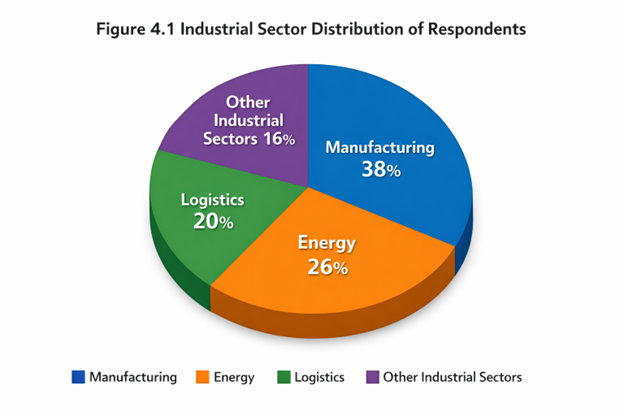
Methodology: The research design used in this study was quantitative. The structured questionnaire was the means by which primary data were collected through distributing the survey to professionals operating in the industrial sectors, including manufacturing, energy, and logistics. A mean score of 150 valid responses was performed in terms of descriptive statistics, correlation analysis and regression analysis to ascertain the relationship between digital technology adoption and reduction of environmental impact.
Results: According to the findings, digital technologies are very applicable in increasing environmental monitoring abilities and add to environmental sustainability. Internet of Things monitoring systems exert the biggest impacts in reduction of the environmental impact, followed by artificial intelligence and big data analytics.
Conclusion: The paper comes to a conclusion that digital technologies in the industrial processes can enhance environmental monitoring and lessen the effects on the environment. Development of a sustainable industrial system and the improvement of practical environmental management can be, therefore, supported with the adoption of the newest digital technologies.
Downloads
References
Ahmad, N. R. (2025). The impact of fintech startups on financial innovation and stability in Pakistan’s evolving financial landscape. International Journal of Financial Innovation, 8(1), 112–126.
Bibri, S. E. (2023). The convergence of artificial intelligence, IoT, and big data for environmentally sustainable smart cities. Sustainable Cities and Society, 92, 104452.
Feroz, A. K., Zo, H., & Chiravuri, A. (2021). Digital transformation and environmental sustainability: A review and research agenda. Sustainability, 13(3), 1530.
Florek-Paszkowska, A., & Hoyos-Gómez, M. (2025). The digital-sustainability ecosystem: A conceptual framework for digital transformation and sustainable innovation. Journal of Entrepreneurship, Management and Innovation, 21(2), 23–47.
Goel, A. (2024). Digital transformation and environmental sustainability: Opportunities and challenges. Sustainability, 16(24), 11079.
Hariyani, D., et al. (2025). Digital technologies for achieving the sustainable development goals. Green Technology and Sustainability, 3(2), 1–15.
Lanfranchi, G., et al. (2025). Internet of Things and environmental sustainability: Applications and research directions. Corporate Social Responsibility and Environmental Management, 32(2), 345–358.
Lubis, S., et al. (2025). Big data analytics for environmental monitoring and sustainability management. SN Applied Sciences, 7, 1125.
Olawade, D. B., et al. (2024). Artificial intelligence in environmental monitoring: Applications and challenges. Environmental Research Communications, 6(3), 035012.
Okot, T., & Ssewanyana, J. (2023). The Internet of Things for sustainability: A conceptual framework for digital environmental management. Journal of Technology Management & Innovation, 18(4), 65–79.
Pricopoaia, O., et al. (2025). The implications of digital transformation and environmental innovation for sustainability. Journal of Cleaner Production, 427, 139343.
Sharma, A., Singh, K. J., Kapoor, D. S., Thakur, K., & Mahajan, S. (2025). The role of IoT in environmental sustainability: Advancements and applications for smart cities. In Mobile Crowdsensing and Remote Sensing in Smart Cities. Springer.
Strader, T. (2025). Artificial intelligence and environmental sustainability: A structured literature review. Journal of Information Technology and Innovation Management, 10(2), 45–60.
Bindeeba, D. S., et al. (2025). Digital levers for sustainability: A meta-analytic review of digital transformation and ESG performance. Cogent Business & Management, 12(1), 2564919.
Jagatheesaperumal, S. K., Rahouti, M., Ahmad, K., Al-Fuqaha, A., & Guizani, M. (2021). The duo of artificial intelligence and big data for Industry 4.0: Applications and future research directions. IEEE Access, 9, 82823–82844.
Gangwar, A., Singh, S., Mishra, R., & Prakash, S. (2023). Air pollution monitoring and forecasting using IoT, big data, and machine learning technologies. Environmental Monitoring and Assessment, 195, 468.
Daily, B. F., & Huang, S. (2001). Achieving sustainability through attention to human resource factors in environmental management. International Journal of Operations & Production Management, 21(12), 1539–1552.
Dubey, R., Gunasekaran, A., Childe, S. J., Papadopoulos, T., & Fosso Wamba, S. (2019). Big data analytics and artificial intelligence pathway to operational performance under the effects of entrepreneurial orientation and environmental dynamism. Technological Forecasting and Social Change, 146, 210–227.
Elkington, J. (1998). Cannibals with forks: The triple bottom line of 21st century business. New Society Publishers.
Geissdoerfer, M., Savaget, P., Bocken, N., & Hultink, E. (2017). The circular economy: A new sustainability paradigm. Journal of Cleaner Production, 143, 757–768.
Gubbi, J., Buyya, R., Marusic, S., & Palaniswami, M. (2013). Internet of Things (IoT): A vision, architectural elements, and future directions. Future Generation Computer Systems, 29(7), 1645–1660.
Hart, S. L. (1995). A natural-resource-based view of the firm. Academy of Management Review, 20(4), 986–1014.
Hilty, L. M., & Aebischer, B. (2015). ICT innovations for sustainability. Advances in Intelligent Systems and Computing, 310, 3–36.
Kshetri, N. (2018). Blockchain’s roles in meeting key supply chain management objectives. International Journal of Information Management, 39, 80–89.
Lasi, H., Fettke, P., Kemper, H., Feld, T., & Hoffmann, M. (2014). Industry 4.0. Business & Information Systems Engineering, 6(4), 239–242.
Mol, A. P., & Spaargaren, G. (2000). Ecological modernization theory in debate. Environmental Politics, 9(1), 17–49.
Rolnick, D., et al. (2019). Tackling climate change with machine learning. ACM Computing Surveys, 55(2), 1–96.
Stock, T., & Seliger, G. (2016). Opportunities of sustainable manufacturing in Industry 4.0. Procedia CIRP, 40, 536–541.
Tornatzky, L., & Fleischer, M. (1990). The processes of technological innovation. Lexington Books.
Vinuesa, R., et al. (2020). The role of artificial intelligence in achieving the Sustainable Development Goals. Nature Communications, 11, 233.
Wang, G., Gunasekaran, A., Ngai, E., & Papadopoulos, T. (2016). Big data analytics in logistics and supply chain management. International Journal of Production Economics, 176, 98–110.
Zanella, A., Bui, N., Castellani, A., Vangelista, L., & Zorzi, M. (2014). Internet of Things for smart cities. IEEE Internet of Things Journal, 1(1), 22–32.
Zhang, Y., Wang, L., & Chen, Y. (2021). Digital technologies and environmental governance: Evidence from industrial monitoring systems. Journal of Environmental Management, 289, 112502.
Bocken, N. M. P., & Short, S. (2021). Sustainable business model innovation and digital transformation. Journal of Cleaner Production, 279, 123–144.
Bonilla, S., Silva, H., & Terra, A. (2020). Industry 4.0 and environmental sustainability: A systematic review. Environmental Science and Pollution Research, 27(25), 31681–31697.
Dwivedi, Y. K., Hughes, L., Ismagilova, E., Aarts, G., Coombs, C., Crick, T., & Williams, M. (2021). Artificial intelligence (AI): Multidisciplinary perspectives on emerging challenges and opportunities. International Journal of Information Management, 57, 101994.
Gupta, M., Kar, A. K., & Ilavarasan, P. V. (2018). Big data analytics in sustainable operations management. Annals of Operations Research, 270(1), 195–213.
Kumar, S., Singh, R., & Kumar, N. (2021). Internet of Things applications for environmental monitoring and sustainability. Sustainable Computing: Informatics and Systems, 30, 100–112.
Li, L., Dai, J., & Cui, L. (2020). Digital transformation for sustainable manufacturing. International Journal of Production Economics, 220, 107–121.
Rai, A., Constantinides, P., & Sarker, S. (2019). Next-generation digital platforms: Toward human–AI hybrids. MIS Quarterly, 43(1), iii–ix.
Downloads
Published
Issue
Section
Categories
License
Copyright (c) 2026 Aftab Ahmad, Gulfan Ullah, Kamran Ullah Khan, Muhammed Adil Khan, Basmina (Author)

This work is licensed under a Creative Commons Attribution 4.0 International License.
How to Cite