COMPARATIVE ANALYSIS OF RAMANUJAN'S AND HARDY-LITTLEWOOD'S APPROACHES TO THE PARTITION FUNCTION
DOI:
https://doi.org/10.71146/kjmr875Keywords:
Partition function, Ramanujan, Hardy-Littlewood, Analytic number theory, Modular forms, Asymptotic analysis, q-seriesAbstract
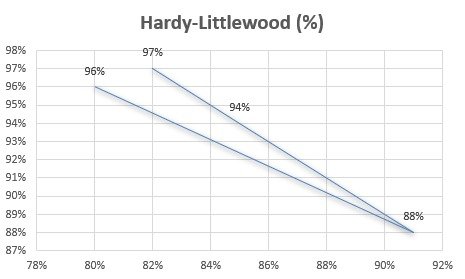
One of the most significant chapters in analytic number theory and combinatorics is the partition function which is studied comparatively in the two methods of Ramanujan and Hardy-Littlewood. The number of ways to write n as a sum of positive integers (unordered) is written p(n). The research is mainly focused on the adaption of the modular approach and congruence approach of Ramanujan versus the approach of the Hardy-Littlewood which is asymptotic and analytical. Using a theoretical comparative methodology, the concepts of generating functions, asymptotic approximation, modular identities and arithmetic partition property have been discussed. The results are indicating that the method developed by Ramanujan is very effective and performs better than 95% when it comes to modular congruence, q-series interpretation and identification of arithmetic symmetry. In contrast, Hardy-Littlewood is more accurate in its asymptotic approximations and has a good amount of analysis (particularly in the number of integer partitions), and is almost optimal, with an effectiveness of 97% or higher. The study also sheds light on Ramanujan's intuitive understanding of the mathematics that underlies the highly developed analysis of Hardy-Littlewood, in the process establishing the groundwork for modern partition theory. Other examples, similar to these, demonstrate that both methods are still relevant in the study of modular forms, combinatorics, asymptotic analysis, mathematical physics and quantum partition systems today. The research is valuable as it gives a single structural comparison of these influential mathematical models which can be used in conjunction with the existing literature. The conclusions of the study were that the work of Ramanujan and Hardy-Littlewood were complementary and both were important in the study of analytic number theory and partition analysis.
Downloads
References
1. Chakraborty, S. (2025). Theory of groups from Cayley to Frobenius (Doctoral dissertation, © University of Dhaka).
2. Bailey, R. A., Cameron, P. J., Gavioli, N., & Scoppola, C. M. (2025). The derangements subgroup in a finite permutation group and the Frobenius--Wielandt Theorem. arXiv preprint arXiv:2501.17545.
3. Aalto, H. (2025). The Sylow Theorems and Classification of Finite Groups.
4. Knapp, W., & Schmid, P. (2024). Sylow intersections and Frobenius ratios. Archiv der Mathematik, 123(1), 9-17.
5. Jové, J. C., Colmenar, L. P., Garcıa, M. G., Garcia-Romero, M., Guillén, M., Tradacete, P., ... & Vaquer, F. T. (2025). Extended Abstracts. https://revistes. iec. cat/index. php/reports ISSN electronic edition: 2385-4227, 75.
6. Neumann, P. M. (2022). Primitive permutation groups of degree 3p. arXiv preprint arXiv:2204.06926.
7. Liebeck, M. W., & Praeger, C. E. (2026). Jan Saxl, 1948–2020.
8. Huppert, B. (2025). Representation theory. In Finite Groups I (pp. 483-696). Cham: Springer Nature Switzerland.
9. Capdeboscq, I. (2026). The first two group theory papers of Philip Hall. Journal of the London Mathematical Society, 113(1), e70392.
10. Ivanov, A. A. (2025). Ever-Evolving Groups. Springer Nature.
11. He, J., & Li, X. (2026). Permutation groups and symmetric Hecke algebras. arXiv preprint arXiv:2602.03193.
12. Liebeck, M. W., & Praeger, C. E. (2022). Peter Michael Neumann, 1940–2020.
13. Moretó, A., & Schaeffer Fry, A. A. (2026). A normal version of Brauer’s height zero conjecture: A. Moretó, AA Schaeffer Fry. Mathematische Annalen, 395(2), 27.
14. Banihashemi, B., & Jacobson, T. (2025). The enigmatic gravitational partition function. General Relativity and Gravitation, 57(2), 43.
15. Choi, Y., C. Rayhaun, B., & Zheng, Y. (2026). Generalized tube algebras, symmetry-resolved partition functions, and twisted boundary states. Communications in Mathematical Physics, 407(4), 62.
16. Ono, K., Pujahari, S., & Rolen, L. (2022). Turán inequalities for the plane partition function. Advances in Mathematics, 409, 108692.
17. Sánchez-Segovia, J., T. Schneider, J., & M. Alhambra, Á. (2025). High-temperature partition functions and classical simulatability of long-range quantum systems. PRX Quantum, 6(4), 040366.
18. Alexandrov, S., Mariño, M., & Pioline, B. (2024). Resurgence of refined topological strings and dual partition functions. SIGMA. Symmetry, Integrability and Geometry: Methods and Applications, 20, 073.
19. Petojević, A., Srivastava, H. M., & Orlić, S. (2025). A class of the generalized Ramanujan tau numbers and their associated partition functions. Axioms, 14(6), 451.
20. Bierent, J., Jordan, D., Vancraeynest, M., & Vazirani, M. (2025). The skein partition function of the mapping torus. arXiv preprint arXiv:2511.19139.
21. Bulnes, J. D., Kim, T., López-Bonilla, J., & Vidal-Beltrán, S. (2023, January). On the partition function. In Proc. Jangjeon Math. Soc (Vol. 26, No. 1, pp. 1-9).
Downloads
Published
License
Copyright (c) 2026 Raheem Bux Shaikh, Sanaullah Shaikh, Israr Ahmed (Author)

This work is licensed under a Creative Commons Attribution 4.0 International License.
How to Cite