ASSESSMENT OF MYCOTOXINS IN MAIZE AND ASSOCIATED DIETARY RISK IN SINDH PAKISTAN
DOI:
https://doi.org/10.71146/kjmr872Keywords:
Mycotoxins, Maize, Aflatoxins, Ochratoxins, Food toxicity, PakistanAbstract
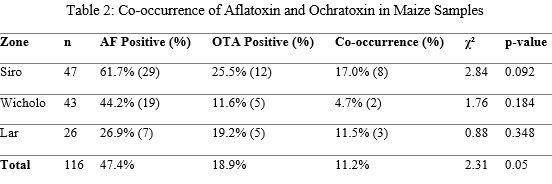
A study was conducted to determine the natural co-occurrence of mycotoxins (aflatoxins and ochratoxins) in maize grown in Sindh, Pakistan. Mycotoxins were determined by using competitive enzyme linked immunosorbent assay. Aflatoxins were detected in 47.4% of samples (1.4–67.7 µg/kg), with 24.1% exceeding the maximum residue limit (MRL, 20 µg/kg). ochratoxin was detected in 19.0% of samples (1–35.5 µg/kg), with 3.4 % exceeding the MRL (5 µg/kg). Co-occurrence was found in 11.2 % and observed no significant association statistically (p>0.05). Furthermore, a dietary risk assessment was calculated with mean and worst-case exposure and observed that aflatoxins posed a significant health concern yield a low margin of exposure (MOE: 17.39 and 3.55, respectively). Similarly, ochratoxins exposure through the maize exceeded 3.48-fold tolerable daily intake at worst case scenario. These findings highlight substantial contamination and associated health risks in maize from Sindh.
Downloads
References
(EC)No1881. (2006). Commission Regulation (EC) No. 1881/2006 of 19 December 2006 setting maximum levels for certain contaminants in foodstuffs. Official Journal of the European Union, L364, 5–24. https://eur-lex.europa.eu/eli/reg/2006/1881/oj/eng
Ahmada, N. S., Arif, A. T., Sadiqa, S. B., Çelikc, E., Mahmoodd, M. A., Radhae, K. M., Ahmade, D. S., & Hasane, J. A. (2025). Carcinogenic Mycotoxins in Common Foods: ELISA-Based Measurement of Aflatoxins and Ochratoxins. Sulaimani Journal for Pure and Applied Sciences, 27(2), 127–138.
Alshannaq, A., & Yu, J.-H. (2017). Occurrence, toxicity, and analysis of major mycotoxins in food. International journal of environmental research and public health, 14(6), 632.
Asghar, M. A., Ahmed, A., & Asghar, M. A. (2020). Influence of temperature and environmental conditions on aflatoxin contamination in maize collected from different regions of Pakistan during 2016–2019. Journal of stored products research, 88, 101637.
Ashraf, W., Rehman, A., Rabbani, M., Shaukat, W., & Wang, J.-S. (2023). Aflatoxins posing threat to food safety and security in Pakistan: Call for a one health approach. Food and Chemical Toxicology, 180, 114006.
Bereziartua, A., Huss, A., Kers, J. G., Smit, L. A., Vermeulen, R., & Figueiredo, D. M. (2025). Pre-harvest aflatoxin contamination in crops and climate change factors: a European overview. Toxins, 17(7), 344.
Bräse, S., Encinas, A., Keck, J., & Nising, C. F. (2009). Chemistry and biology of mycotoxins and related fungal metabolites. Chemical reviews, 109(9), 3903–3990.
Directive, C. (2002/27/EC). Commission Directive 2002/27/EC of 13 March 2002 amending Directive 98/53/EC laying down the sampling methods and the methods of analysis for the official control of the levels for certain contaminants in foodstuffs (Text with EEA relevance).
Eskola, M., Kos, G., Elliott, C. T., Hajšlová, J., Mayar, S., & Krska, R. (2020). Worldwide contamination of food-crops with mycotoxins: Validity of the widely cited ‘FAO estimate’of 25%. Critical reviews in food science and nutrition, 60(16), 2773–2789.
EuropeanCommission. (2023). European Commission. (2023, April 25). Commission Regulation (EU) 2023/915 of 25 April 2023 on maximum levels for certain contaminants in food and repealing Regulation (EC) No 1881/2006. Official Journal of the European Union.
FAO. (2013). Mycotoxins: Food Safety and Quality. Rome: Food and Agriculture Organization of the United Nations. https://www.fao.org/food/food-safety-quality/a-z-index/mycotoxins/en/
FDA. ( 2021). U.S. Food and Drug Administration. (2021, June). CPG Sec. 555.400 aflatoxins in human food. https://www.fda.gov/regulatory-information/search-fda-guidance-documents/cpg-sec-555400-aflatoxins-human-food.
Ficheux, A., Sibiril, Y., & Parent-Massin, D. (2012). Co-exposure of Fusarium mycotoxins: in vitro myelotoxicity assessment on human hematopoietic progenitors. Toxicon, 60(6), 1171–1179.
Ghiasian, S., Shephard, G., & Yazdanpanah, H. (2011). Natural occurrence of aflatoxins from maize in Iran. Mycopathologia, 172(2), 153–160.
Gillani, S. W. u. H. S., Sadef, Y., Imran, M., Raza, H. M. F., Ghani, A., Anwar, S., Ashraf, M. Y., & Hussain, S. (2022). Determination and detoxification of aflatoxin and ochratoxin in maize from different regions of Pakistan. Environmental monitoring and assessment, 194(9), 613.
Giray, B., Atasayar, S., & Sahin, G. (2009). Determinatıon of ochratoxin A and total aflatoxin levels in corn samples from Turkey by enzyme-linked immunosorbent assay. Mycotoxin research, 25(2), 113–116.
Group, S. (2025). Comprehensive review of maize grain in Pakistan. https://saremco.com.pk/comprehensive-review-of-maize-grain-in-pakistan/
Hell, K., Cardwell, K. F., Setamou, M., & Poehling, H.-M. (2000). The influence of storage practices on aflatoxin contamination in maize in four agroecological zones of Benin, West Africa. Journal of stored products research, 36(4), 365–382.
Iram, W., Anjum, T., Abbas, M., & Khan, A. M. (2014). Aflatoxins and ochratoxin A in maize of Punjab, Pakistan. Food Additives & Contaminants: Part B, 7(1), 57–62.
Javed, A., Ahmad, W., Abbas, Y., Maqbool, A., & Javeed, M. N. (2024). POST-HARVEST LOSSES OF MAIZE SUPPLY CHAIN IN PUNJAB, PAKISTAN. Agricultural Sciences Journal(1), 1–12.
Khatoon, S., Hanif, N. Q., Tahira, I., Sultana, N., Sultana, K., & Ayub, N. (2012). Natural occurrence of aflatoxins, zearalenone and trichothecenes in maize grown in Pakistan. Pak. J. Bot, 44(1), 231–236.
Kimanya, M. E., De Meulenaer, B., Tiisekwa, B., Ndomondo-Sigonda, M., Devlieghere, F., Van Camp, J., & Kolsteren, P. (2008). Co-occurrence of fumonisins with aflatoxins in home-stored maize for human consumption in rural villages of Tanzania. Food Additives and Contaminants, 25(11), 1353–1364.
Lewis, L., Onsongo, M., Njapau, H., Schurz-Rogers, H., Luber, G., Kieszak, S., Nyamongo, J., Backer, L., Dahiye, A. M., & Misore, A. (2005). Aflatoxin contamination of commercial maize products during an outbreak of acute aflatoxicosis in eastern and central Kenya. Environmental health perspectives, 113(12), 1763.
Lyon, F. (1994). IARC monographs on the evaluation of carcinogenic risks to humans. Some industrial chemicals, 60, 389–433.
Majeed, S., Iqbal, M., Asi, M. R., & Iqbal, S. Z. (2013). Aflatoxins and ochratoxin A contamination in rice, corn and corn products from Punjab, Pakistan. Journal of Cereal Science, 58(3), 446–450.
Malir, F., Ostry, V., Pfohl-Leszkowicz, A., Malir, J., & Toman, J. (2016). Ochratoxin A: 50 years of research. Toxins, 8(7), 191.
Niaz, I., & Dawar, S. (2012). Detection of mycotoxins in maize seed samples.
Panel, E. C., Schrenk, D., Bignami, M., Bodin, L., Chipman, J. K., Del Mazo, J., Grasl-Kraupp, B., Hogstrand, C., Hoogenboom, L. R., & Leblanc, J.-C. (2020). Risk assessment of aflatoxins in food.
Pleadin, J., Staver, M. M., Markov, K., Frece, J., Zadravec, M., Jaki, V., Krupić, I., & Vahčić, N. (2017). Mycotoxins in organic and conventional cereals and cereal products grown and marketed in Croatia. Mycotoxin research, 33(3), 219–227.
PSQCA. (2022). Pakistan Standards and Quality Control Authority. (2022). Pakistan standard specification for curry powder (3rd Rev.) (PS 1741-2022). Ministry of Science and Technology. https://psqca.com.pk/cs/newitems2021/agri/newharcompayaz2021/PS1741-2022forCurryPowder3rdRev.pdf
Qazi, J. I., & Fayyaz, Z. (2006). Aflatoxin contaminated foods and health risk perspective for Pakistani population. Mycopath, 4(2), 27–34.
Rao, T. A., Shaikh, A. H., & Ahmed, M. (2009). Airborne fungal flora of Karachi, Pakistan. Pakistan Journal of Botany, 41(3), 1421–1428.
Shafique, S., Mukhtar, S., Hani, U., & Iram, S. (2020). Scenario Of Aspergillus Indoor Contamination In Pakistan (2000-2020)–A Review. ENVIRONMENTAL CONTAMINANTS REVIEWS Учредители: ZIbeline International Publishing, 4(1), 24–28.
Shah, H. U., Simpson, T. J., Alam, S., Khattak, K. F., & Perveen, S. (2010). Mould incidence and mycotoxin contamination in maize kernels from Swat Valley, North West Frontier Province of Pakistan. Food and Chemical Toxicology, 48(4), 1111–1116.
Shar, Z., Sumbal, G., Sherazi, S., Bhanger, M., & Nizamani, S. (2014). Natural co-occurrence of aflatoxins and deoxynivalenol in poultry feed in Pakistan. Food Additives & Contaminants: Part B, 7(3), 162–167.
Tangendjaja, B., Rachmawati, S., & Wina, E. (2008). Mycotoxin contamination on corn used by feed mills in Indonesia. Indonesian Journal of Agricultural Science, 9(2), 68–76.
Tangendjaja, B., Rachmawati, S., & Wina, E. (2008). Origins and factors associated with mycotoxins level in corn used as animal feed in Indonesia. Indones. J. Agric. Sci, 9, 68–76.
ul Hassan, S. W., Sadef, Y., Hussain, S., Asi, M. R., Ashraf, M. Y., Anwar, S., & Malik, A. (2020). Unusual pattern of aflatoxins and ochratoxin in commercially grown maize varieties of Pakistan. Toxicon, 182, 66–71.
Villa, P., & Markaki, P. (2009). Aflatoxin B1 and ochratoxin A in breakfast cereals from Athens market: Occurrence and risk assessment. Food Control, 20(5), 455–461.
Zafar, F., Yasmin, N., Hassan, R., Naim, T., & Qureshi, A. (2001). A study on the analysis of ochratoxin-A in different poultry feed ingredients. Pakistan journal of pharmaceutical sciences, 14(2), 5–7.
Zaid, H. (2025). Maize on the rise. https://www.thenews.com.pk/magazine/money-matters/1300911-maize-on-the-rise#:~:text=By%20Hadia%20Zaid,per%20cent%20($42%20million).
Zheng, Y., Wu, W., Sun, C., Liu, H., & Dou, J. (2024). Occurrence and fate analysis of mycotoxins in maize during the post-harvest period. Toxins, 16(11), 459.
Zinedine, A., & Mañes, J. (2009). Occurrence and legislation of mycotoxins in food and feed from Morocco. Food Control, 20(4), 334–344.
Downloads
Published
License
Copyright (c) 2026 Zahid H Shar, Javed Hussain, Pirah, Muhammad Kashif Channa, Muhammad Ashraf Bajeer, Eidal Khan, Gul Afshan Soomro, Gul Afshan Soomro, Gul Afshan Soomro (Author)

This work is licensed under a Creative Commons Attribution 4.0 International License.
How to Cite