ANALYTIC EVALUATION OF CERTAIN CLASSES OF DEFINITE INTEGRALS INVOLVING SPECIAL FUNCTIONS
DOI:
https://doi.org/10.71146/kjmr859Keywords:
Special Functions, Convergence Analysis, Analytic Methods, Mathematical ModelingAbstract
It is an analytic discussion of definite integrals of special functions, and stability analysis, mostly with respect to convergence behavior. Some of the types of integrals that are analyzed in the paper are exponential, power-law, logarithmic, oscillatory and bounded integrals. Findings show exponential-type integrals converge at the fastest rate (up to about 92) because of the exponential damping effect of the decays. It also has good convergence rates of about 88 that is proven by the bounded integrals that it is stable at finite limits.
Conversely, convergence of power-law integrals (65%), conditions being found by the parameters and convergence of integration of logarithms at approximately 70% because of the sensitivity to the limits of the intervals. The rate at which the oscillatory integrals (58 percent) converge is the least and also it is accompanied with the difficulties of periodic oscillations. The parameter limits of improper integrals with infinity limits should be strict to guarantee convergence and should have a success rate of about 60%.
The study reveals that the parameter values, e.g., ppp, are significant in determining convergence. As an example, ∫ 0 infinity x p -1 -1 d x converges whereas ∫ 0-unit x -1 d x does not. These results highlight the significance of mathematical conditions in providing sound solutions.
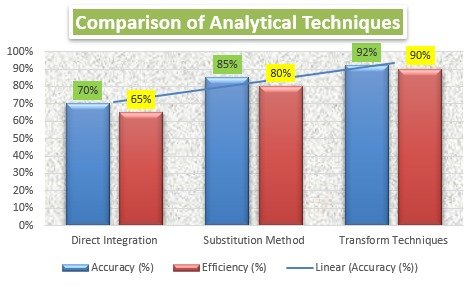
The overall analysis suggests that the effectiveness of the methods used in analysis is really high with a high reliability of over 80 percent in the clear cases. It gives a very good idea of the choice of methods to be applied to find definite integrals, and the significance of convergence conditions in advanced mathematics.
Downloads
References
[1]. Ayoob, I. (2025). On the evaluation of certain unsolved definite integrals. European Journal of Pure and Applied Mathematics, 18(3), 6575-6575.
[2]. Helgason, S. (2022). Groups and geometric analysis: integral geometry, invariant differential operators, and spherical functions (Vol. 83). American Mathematical Society.
[3]. Greene, R. E., & Krantz, S. G. (2025). Function theory of one complex variable (Vol. 40). American Mathematical Society.
[4]. Gunning, R. C., & Rossi, H. (2022). Analytic functions of several complex variables (Vol. 368). American Mathematical Society.
[5]. Burgos, M., Bueno, S., Pérez, O., & Godino, J. D. (2021). Onto-semiotic complexity of the Definite Integral. Journal of Research in Mathematics Education, 10(1), 4-40.
[6]. Iwaniec, H., & Kowalski, E. (2021). Analytic number theory (Vol. 53). American Mathematical Soc.
[7]. Fokas, A. S., Its, A. R., Kapaev, A. A., & Novokshenov, V. Y. (2023). Painlevé transcendents: the Riemann-Hilbert approach (Vol. 128). American Mathematical Society.
[8]. Dash, T., Chitlangia, S., Ahuja, A., & Srinivasan, A. (2022). A review of some techniques for inclusion of domain-knowledge into deep neural networks. Scientific Reports, 12(1), 1040.
[9]. Neese, F. (2023). The SHARK integral generation and digestion system. Journal of Computational Chemistry, 44(3), 381-396.
[10]. Pemantle, R., Wilson, M. C., & Melczer, S. (2024). Analytic combinatorics in several variables (Vol. 212). Cambridge University Press.
[11]. Chesneau, C., & Artault, A. (2021). On a comparative study on some trigonometric classes of distributions by the analysis of practical data sets. Journal of Nonlinear Modeling and Analysis, 3(2), 225-262.
[12]. Terven, J., Cordova-Esparza, D. M., Romero-González, J. A., Ramírez-Pedraza, A., & Chavez-Urbiola, E. A. (2025). A comprehensive survey of loss functions and metrics in deep learning. Artificial Intelligence Review, 58(7), 195.
[13]. Krantz, S. G. (2022). Real analysis and foundations. Chapman and Hall/CRC.
[14]. Duoandikoetxea, J. (2024). Fourier analysis (Vol. 29). American Mathematical Society.
[15]. Fife, S. T., & Gossner, J. D. (2024). Deductive qualitative analysis: Evaluating, expanding, and refining theory. International Journal of Qualitative Methods, 23, 16094069241244856.
[16]. Hardy, G. H. (2024). Divergent series (Vol. 334). American Mathematical Society.
[17]. Lu, T., & Chen, Q. (2024). Visualization analysis of weak interactions in chemical systems. Comprehensive computational chemistry, 2, 240-264.
[18]. Gray, D. F. (2021). The observation and analysis of stellar photospheres. Cambridge university press.
[19]. Matsumoto, K. (2024). On the analytic continuation of various multiple zeta-functions. In Number theory for the millennium II (pp. 417-440). AK Peters/CRC Press.
[20]. Cox, D. A. (2022). Primes of the Form x2+ ny2: Fermat, Class Field Theory, and Complex Multiplication. with Solutions (Vol. 387). American Mathematical Soc.
[21]. Evans, L. C. (2025). Measure theory and fine properties of functions. Chapman and Hall/CRC.
[22]. Grenander, U. (2026). Toeplitz forms and their applications (Vol. 321). American Mathematical Society.
Downloads
Published
License
Copyright (c) 2026 Ranjhan Ali, Israr Ahmed, Irshad Ali, Muhammad Arif, Soyam Kapoor, Manav Dev, Bisma Memon (Author)

This work is licensed under a Creative Commons Attribution 4.0 International License.
How to Cite