APHRODISIAC ACTIVITY OF VITIS VINIFERA JUICE IN WISTAR RATS
DOI:
https://doi.org/10.71146/kjmr858Keywords:
Vitis vinifera, Aphrodisiac activity, Mounting behaviour, Mating performanceAbstract
Background: It has been known for over 6000 years that Vitis vinifera, grapes have therapeutic properties. The grape's leaves have been used to treat diarrhea. The grape leaves were also used to treat bleeding, inflammatory, and analgesic diseases. Sore throats have been treated with unripe grapes. Constipation was treated with raisins.
In this study, we assessed the aphrodisiac potential of Vitis vinifera juice in Wistar rats.
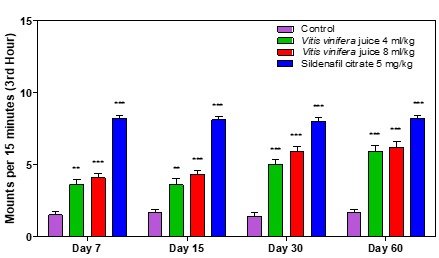
Material and method: In this study mounting behaviour test, mating performance test and orientation activities of male rats were assessed to observe the effect of the juice on the sexual behaviour of the rats. The juice was given orally by gavage at the two doses of 4 ml/kg and 8 ml/kg. Sildenafil citrate (5 mg/kg) was utilized as the control drug.
Result: The results of the analysis reveal that the number of mounts was significantly increased in treated groups when compared with the saline-treated group. the number of sperm positive females per cage was significantly increased in treated groups when compared with the saline-treated group. the number of anogenital sniffing, lickings, climbing’s and genital grooming were significantly increased in treated groups when compared with the saline-treated group.
Conclusion: Vitis vinifera juice has shown a significant aphrodisiac activity in Wistar rats. This activity could be due to its elevating effect on noradrenaline levels in the brain of the animals.
Downloads
References
Byard, R. A review of the potential forensic significance of traditional herbal medicines. Journal of Forensic Sciences, 2010, 55(1), 89-92.
Ziskind, B., & Halioua, B. Occupational medicine in ancient Egypt. Medical Hypotheses, 2007, 69(4), 942-945.
Ali, K., Maltese, F., Choi, Y., & Verpoorte, R. Metabolic constituents of grapevine and grape-derived products. Phytochem Rev, 2009,9(3), 357-378.
Sun, B., Ribes, A., Leandro, M., Belchior, A., & Spranger, M. Stilbenes: Quantitative extraction from grape skins, contribution of grape solids to wine and variation during wine maturation. Analytica Chimica Acta, 2006, 563(1-2), 382-390.
Shi, J., Yu, J., Pohorly, J., & Kakuda, Y. Polyphenolics in Grape Seeds—Biochemistry and Functionality. Journal of Medicinal Food, 2003, 6(4), 291-299.
Preuss, H., Bagchi, D., & Bagchi, M. Protective Effects of a Novel Niacin-Bound Chromium Complex and a Grape Seed Proanthocyanidin Extract on Advancing Age and Various Aspects of Syndrome X. Annals of the New York Academy of Sciences, 2002, 957(1), 250-259.
Lasuncio´n, M., Castilla, P., Echarri, R., Ortega, H., & Teruel, J. Antioxidant and hypolipidemic effects of a red grape juice supplement in hemodialysis patients. Clinical Nutrition, 2003, 22, S20.
Brooker, S., Martin, S., Pearson, A., Bagchi, D., Earl, J., & Gothard, L. et al. Double-blind, placebo-controlled, randomized phase II trial of IH636 grape seed proanthocyanidin extract (GSPE) in patients with radiation-induced breast induration. Radiotherapy and Oncology, 2006, 79(1), 45-51.
Kar, P., Laight, D., Rooprai, H., Shaw, K., & Cummings, M. Effects of grape seed extract in Type 2 diabetic subjects at high cardiovascular risk: a double-blind randomized placebo-controlled trial examining metabolic markers, vascular tone, inflammation, oxidative stress and insulin sensitivity. Diabetic Medicine, 2009, 26(5), 526-531.
Mellen, P., Daniel, K., Brosnihan, K., Hansen, K., & Herrington, D. Effect of muscadine grape seed supplementation on vascular function in subjects with or at risk for cardiovascular disease: A randomized crossover trial. Journal of the American College of Nutrition, 2010, 29(5), 469-475.
Tajuddin, Ahmad, S., Latif, A., & Qasmi, I. Aphrodisiac activity of 50% ethanolic extracts of Myristica fragrans Houtt. (Nutmeg) and Syzygium aromaticum (L) Merr. & Perry. (clove) in male mice: A comparative study. BMC Complementary and Alternative Medicine, 2003, 3(1), 6.
Aslam, M., & Sial, A. Effect of Hydroalcoholic Extract of Cydonia oblonga Miller (Quince) on sexual behaviour of Wistar rats. Advances in Pharmacological Sciences, 2014, 2014, 1-6.
Hull, E., & Dominguez, J. Sexual behavior in male rodents. Hormones and Behavior, 2007, 52(1), 45-55.
Natella, F., Belelli, F., Gentili, V., Ursini, F., & Scaccini, C. Grape seed proanthocyanidins prevent plasma postprandial oxidative stress in humans. J. Agric. Food Chem., 2002, 50(26), 7720-7725.
Sharma, G., Tyagi, A., Singh, R., Chan, D., & Agarwal, R. Synergistic anti-cancer effects of grape seed extract and conventional cytotoxic agent doxorubicin against human breast carcinoma cells. Breast Cancer Res Treat, 2004, 85(1), 1-12.
Zhang, F., Gao, H., Wu, J., Ma, Y., You, B., Li, B., & Xuan, J. Selective inhibition by grape seed proanthocyanidin extracts of cell adhesion molecule expression induced by advanced glycation end products in endothelial cells. Journal of Cardiovascular Pharmacology, 2006, 48(2), 47-53.
Aslam M, Sultana N. Vitis vinifera juice ameliorates depression-like behavior in mice by modulating biogenic amine neurotransmitters . Bangladesh J Pharmacol. 2015; 10: 753 -58.
Clark, J., Smith, E., & Davidson, J. Enhancement of sexual motivation in male rats by yohimbine. Science, 1984, 225(4664), 847-849.
Clark, J., Smith, E., & Davidson, J. Evidence for the modulation of sexual behavior by & alpha-adrenoceptors in male rats. Neuroendocrinology, 1985, 41(1), 36-43.
Rodrı́guez-Manzo, G. Yohimbine interacts with the dopaminergic system to reverse sexual satiation: further evidence for a role of sexual motivation in sexual exhaustion. European Journal of Pharmacology, 1999, 372(1), 1-8.
Smith, E., Lee, R., Schnur, S., & Davidson, J. Alpha2-adrenoceptor antagonists and male sexual behavior: I. Mating behavior. Physiology & Behavior, 1987, 41(1), 7-14.
Tallentire, D., McRae, G., Spedding, M., Clark, R., & Vickery, B. Modulation of sexual behaviour in the rat by a potent and selective α2-adrenoceptor antagonist, delequamine (RS-15385-197). British Journal of Pharmacology, 1996, 118(1), 63-72.
Downloads
Published
License
Copyright (c) 2026 Muhammad Aslam, Nuzhat Sultana, Hammad Ahmed (Author)

This work is licensed under a Creative Commons Attribution 4.0 International License.
How to Cite