ERYTHROPOIETIC ACTIVITY OF VITIS VINIFERA IN NEW ZEALAND WHITE RABBITS
DOI:
https://doi.org/10.71146/kjmr825Keywords:
Erythropoietic activity, Vitis vinifera, Hemoglobin, Erythrocyte count, HematocritAbstract
Background:
The knowledge of traditional herbal drugs provides the leads for safer and cheaper herbal medicines. A number of modern pharmaceuticals have been obtained from herbal medicines.
Vitis vinifera, or grapes, have been used medicinally since many decades... Traditionally, several diseases have been treated, using different parts of Vitis vinifera. In this study, we assessed the erythropoietic activity of Vitis vinifera in New Zealand White rabbits.
Material and method: Automated Huma count Plus, Hematology analyzer model # 6400/S, Human Germany was used to analyse the samples of blood. RBC count, hematocrit, hemoglobin (Hb), and mean corpuscular hemoglobin (MCH), mean corpuscular hemoglobin concentration (MCHC) were assessed. The juice was given orally by gavage at the two doses of 4 mL/kg and 8 mLkg.
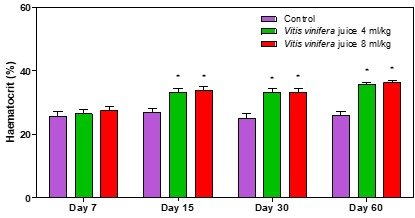
Result: The results of the analysis reveal that erythrocyte count was significantly increased in treated groups when compared with the saline-treated group. Similarly, hemoglobin levels and hematocrit levels were also significantly increased in treated groups when compared with the saline-treated group.
Conclusion: Vitis vinifera juice has shown a significant erythropoietic activity in New Zealand White rabbits. The increase in the level of hemoglobin and erythrocyte counts by Vitis vinifera juice might be related to the antioxidant properties of its constituents and its nutritive potential.
Downloads
References
Vetrichelvan, T., & Jegadeesan, M. Anti-diabetic activity of alcoholic extract of Aerva lanata (L.) Juss. ex-Schultes in rats. Journal of Ethnopharmacology, 2002, 80(2-3), 103-107.
Haq, I. Safety of medicinal plants. Pakistan Journal of Medical Research, 2004, 43(4), 203-210.
Etaware, P. M., America, O., Egara, O. W., Ekun, V. S.Herbal Medicine: Scientific Validation and Future Prospects. International Journal of Pharmacy and Chemistry, 2025, 11(3), 67-75.
ROY, D. H. (2022). Recent Advances in Herbal Medicines – An Updated Review. Asian Journal of Pharmaceutical Research and Development. https://doi.org/10.22270/AJPRD.V10I1.1089
Devasagayam TP. Introduction to serial reviews: recent advances in Indian herbal drug research. J Clin Biochem Nutr. 2007 Mar;40(2):73.
Patwardhan, B. Ethnopharmacology and drug discovery. Journal of Ethnopharmacology, 2005, 100(1-2), 50-52.
Heinrich, M. Ethnomedicine and drug discovery. Journal of Ethnopharmacology, 2002, 82(2-3), 244.
Tamboura, H., Sawadogo, L., Kaboré, H., & Yameogo, S. Ethnoveterinary Medicine and Indigenous Pharmacopoeia of Passoré Province in Burkina Faso. Annals of the New York Academy of Sciences, 2000, 916(1), 259-264.
Liu, Y., & Wang, M. Botanical drugs: Challenges and opportunities. Life Sciences, 2008, 82(9-10), 445-449.
Ziskind, B., & Halioua, B. Occupational medicine in ancient Egypt. Medical Hypotheses, 2007, 69(4), 942-945.
Bowers, J. Historical Genetics: The Parentage of Chardonnay, Gamay, and Other Wine Grapes of Northeastern France. Science, 1999, 285(5433), 1562-1565.
Ali, K., Maltese, F., Choi, Y., & Verpoorte, R. Metabolic constituents of grapevine and grape-derived products. Phytochem Rev, 2009, 9(3), 357-378.
de Almeida Sousa Cruz, M.A., de Barros Elias, M., Calina, D. et al. Insights into grape-derived health benefits: a comprehensive overview. Food Prod Process and Nutr, 2024, 6, 91.
Zhou DD, Li J, Xiong RG, Saimaiti A, Huang SY, Wu SX, Yang ZJ, Shang A, Zhao CN, Gan RY, Li HB. Bioactive Compounds, Health Benefits and Food Applications of Grape. Foods, 2022, 7;11(18):2755.
Tellone, E., De Rosa, M., Pirolli, D., Russo, A., Giardina, B., Galtieri, A., & Ficarra, S. Molecular interactions of hemoglobin with resveratrol: potential protective antioxidant role and metabolic adaptations of the erythrocyte. Biological Chemistry, 2014, 395(3).
Ambali, S., Ayo, J., Ojo, S., & Esievo, K. Ameliorative effect of vitamin C on chronic chlorpyrifos-induced erythrocyte osmotic fragility in Wistar rats. Human & Experimental Toxicology, 2010, 30(1), 19-24.
Opara, E., & Chohan, M. Culinary herbs and spices: Their bioactive properties, the contribution of polyphenols and the challenges in deducing their true health benefits. IJMS, 2014, 15(10), 19183-19202.
Sousa, E., Uchôa-Thomaz, A., Carioca, J., Morais, S., Lima, A., & Martins, C. et al. Chemical composition and bioactive compounds of grape pomace (Vitis vinifera L.), Benitaka variety, grown in the semiarid region of Northeast Brazil. Food Science and Technology (Campinas), 2014, 34(1), 135-142.
Shah, R., Wilson, R., Tang, Y., Dong, X., Murray, A., & Bennett, D. Relation of hemoglobin to level of cognitive function in older persons. Neuroepidemiology, 2009, 32(1), 40-46.
Shah, R., Buchman, A., Wilson, R., Leurgans, S., & Bennett, D. Hemoglobin level in older persons and incident Alzheimer disease: Prospective cohort analysis. Neurology, 2011, 77(3), 219-226.
Downloads
Published
License
Copyright (c) 2026 Muhammad Aslam, Nuzhat Sultan, Fozia Perveen, Shahnaz Niaz, Hammad Ahmed (Author)

This work is licensed under a Creative Commons Attribution 4.0 International License.
How to Cite