BEHAVIORAL ADAPTATIONS AND COGNITIVE FLEXIBILITY IN URBAN BIRDS: UNDERSTANDING SURVIVAL STRATEGIES IN HUMAN-DOMINATED LANDSCAPES
DOI:
https://doi.org/10.71146/kjmr815Keywords:
behavioral adaptation, cognitive flexibility, environmental stressors, urban birds, urban ecology, wildlife adaptationAbstract
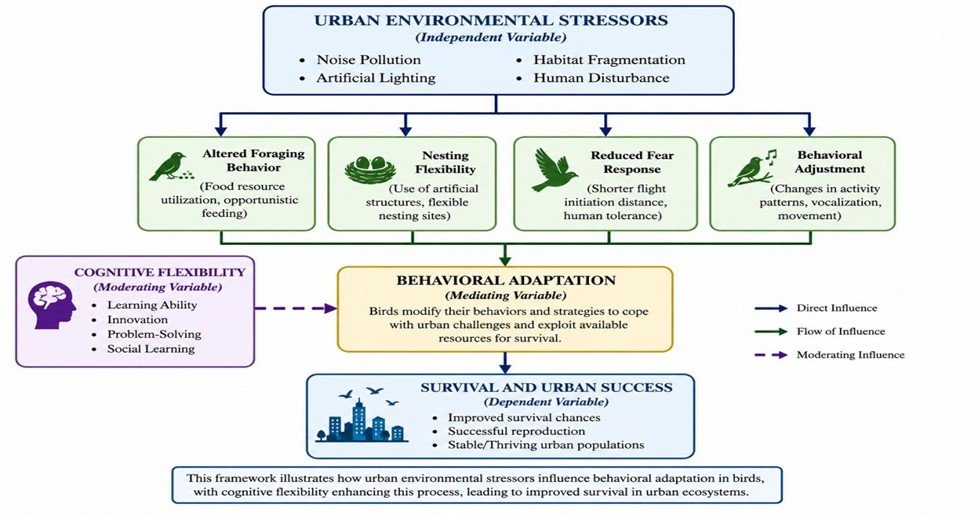
Urbanization transformed natural ecosystems into complex environments where wildlife survival depended on adaptive behavioral and cognitive mechanisms. This study examined behavioral adaptations and cognitive flexibility in urban birds using a quantitative observational design. A sample of 120 birds across multiple urban locations was analyzed to evaluate key behavioral variables, including foraging adaptability, nesting flexibility, flight initiation distance, and problem-solving ability. The results indicated high levels of adaptation, with mean values of 4.18 for problem-solving ability, 4.12 for foraging adaptability, and 4.05 for nesting flexibility. Correlation analysis revealed strong positive relationships between environmental stressors and behavioral adaptation, including habitat fragmentation (r = 0.73), noise pollution (r = 0.71), and artificial lighting (r = 0.68). Comparative analysis showed that crows (4.28) and mynas (4.13) demonstrated higher cognitive flexibility than pigeons (4.00) and sparrows (3.82). These findings indicated that behavioral plasticity and cognitive flexibility played a central role in enabling urban birds to adjust to human-dominated environments. The study contributed to urban ecology by providing empirical evidence on the interaction between environmental pressures and adaptive responses. The results also highlighted the importance of integrating ecological considerations into urban planning to support biodiversity conservation and sustainable ecosystems.
Downloads
References
Aronson, M. F. J., et al. (2014). A global analysis of urbanization impacts on bird diversity. Proceedings of the Royal Society B, 281(1780). https://doi.org/10.1098/rspb.2013.3330
Ashton, B. J., Ridley, A. R., Edwards, E. K., & Thornton, A. (2022). Cognitive performance and environmental adaptation in birds. Trends in Ecology & Evolution, 37(6), 507–519. https://doi.org/10.1016/j.tree.2022.02.003
Audet, J. N., Ducatez, S., & Lefebvre, L. (2021). The role of innovation in urban bird adaptation. Behavioral Ecology, 32(4), 789–798. https://doi.org/10.1093/beheco/arab045
Beninde, J., Veith, M., & Hochkirch, A. (2022). Biodiversity in cities needs space: The role of urban planning. Ecology Letters, 25(3), 580–593. https://doi.org/10.1111/ele.13925
Callaghan, C. T., Major, R. E., Wilshire, J. H., Martin, J. M., Kingsford, R. T., & Cornwell, W. K. (2023). Generalists dominate urban ecosystems. Global Ecology and Biogeography, 32(2), 289–301. https://doi.org/10.1111/geb.13602
Campbell-Staton, S. C., Cheviron, Z. A., & Rochette, N. C. (2021). Urbanization and adaptive evolution. Science, 373(6555), https://doi.org/10.1126/science.aay0785
Dominoni, D. M., et al. (2020). Artificial light and urban bird behavior. Current Biology, 30(11), 2073–2080. https://doi.org/10.1016/j.cub.2020.03.018
Dominoni, D. M., Halfwerk, W., Baird, E., Buxton, R. T., Fernández-Juricic, E., & Barber, J. R. (2021). Light and noise pollution effects on birds. Annual Review of Ecology, Evolution, and Systematics, 52, 463–488. https://doi.org/10.1146/annurev-ecolsys-012021-085843
Ducatez, S., et al. (2022). Cognitive evolution in urban environments. Frontiers in Ecology and Evolution, 10, 953494. https://doi.org/10.3389/fevo.2022.953494
Ducatez, S., Sayol, F., Sol, D., & Lefebvre, L. (2020). Are urban birds more innovative? Nature Communications, 11, 1–9. https://doi.org/10.1038/s41467-020-14507-9
Fischer, J. D., Schneider, S. C., Ahlers, A. A., & Miller, J. R. (2022). Categorizing wildlife responses to urbanization. Landscape and Urban Planning, 225, 104477. https://doi.org/10.1016/j.landurbplan.2022.104477
Gil, D., et al. (2019). Urban noise and avian communication. Behavioral Ecology, 30(4), 987–995. https://doi.org/10.1093/beheco/arz023
Griffin, A. S., et al. (2017). Innovation and behavioral flexibility in birds. Animal Behaviour, 123, 1–12. https://doi.org/10.1016/j.anbehav.2016.10.002
Lefebvre, L., & Sol, D. (2022). Behavioral innovation and urban adaptation. Trends in Ecology & Evolution, 37(2), 101–110. https://doi.org/10.1016/j.tree.2021.09.006
Logan, C. J., Breen, A. J., Gray, R. D., & Taylor, A. H. (2021). Innovation and problem solving in birds. Philosophical Transactions of the Royal Society B, 376(1837), 20200165. https://doi.org/10.1098/rstb.2020.0165
Lowry, H., et al. (2013). Behavioral responses of wildlife to urbanization. Biological Reviews, 88(3), 537–549. https://doi.org/10.1111/brv.12012
Maklakov, A. A., et al. (2021). Cognitive evolution in urban environments. Nature Ecology & Evolution, 5, 128–136. https://doi.org/10.1038/s41559-020-01340-2
Morelli, F., Benedetti, Y., Ibáñez-Álamo, J. D., Jokimäki, J., Mänd, R., Tryjanowski, P., & Møller, A. P. (2021). Global patterns of urban bird diversity. Ecography, 44(5), 727–739. https://doi.org/10.1111/ecog.05464
Norton, B. A., Evans, K. L., & Warren, P. H. (2023). Urban biodiversity and landscape design. Landscape Ecology, 38(1), 15–29. https://doi.org/10.1007/s10980-022-01512-3
Samia, D. S. M., Bessa, E., Blumstein, D. T., Nunes, J. A. C. C., & Santini, L. (2022). Flight initiation distance and urban tolerance. Proceedings of the Royal Society B, 289(1977), 20220037. https://doi.org/10.1098/rspb.2022.0037
Santangelo, J. S., Rivkin, L. R., & Johnson, M. T. J. (2022). The evolution of urban traits. Science, 375(6580), eabj2606. https://doi.org/10.1126/science.abj2606
Schell, C. J., et al. (2021). The ecological and evolutionary consequences of urbanization. Science, 372(6534), eaba6551. https://doi.org/10.1126/science.aba6551
Senzaki, M., Yamaura, Y., Francis, C. D., & Nakamura, F. (2020). Traffic noise reduces bird communication. Ecology Letters, 23(2), 252–262. https://doi.org/10.1111/ele.13418
Shochat, E., et al. (2010). Urban ecology and biodiversity patterns. Trends in Ecology & Evolution, 25(2), 82–90. https://doi.org/10.1016/j.tree.2009.09.007
Sih, A. (2020). Behavioral adaptation in urban systems. Proceedings of the National Academy of Sciences, 117(10), 527–534. https://doi.org/10.1073/pnas.1919384117
Sih, A. (2020). Understanding animal behavior in urban systems. Proceedings of the National Academy of Sciences, 117(10), 527–534. https://doi.org/10.1073/pnas.1919384117
Sol, D., et al. (2020). Behavioral flexibility and urban adaptation. Nature Ecology & Evolution, 4, 128–136. https://doi.org/10.1038/s41559-019-1069-2
Thompson, K. A., Rieseberg, L. H., & Schluter, D. (2022). Speciation and adaptation in cities. Nature Reviews Genetics, 23(7), 423–438. https://doi.org/10.1038/s41576-022-00453-2
Tryjanowski, P., Morelli, F., Mikula, P., Krištín, A., Indykiewicz, P., Grzywaczewski, G., Kronenberg, J., & Jerzak, L. (2021). Bird responses to urbanization. Biological Reviews, 96(2), 813–829. https://doi.org/10.1111/brv.12677
Vincze, E., Papp, S., Preiszner, B., Seress, G., & Liker, A. (2023). Human disturbance and bird behavior. Urban Ecosystems, 26(1), 45–58. https://doi.org/10.1007/s11252-022-01264-3
Weaver, M., & McGraw, K. J. (2022). Urban innovation in birds. Journal of Urban Ecology, 8(1), juac029. https://doi.org/10.1093/jue/juac029
Xia, J. (2025). Behavioral flexibility in urban birds: Nesting adaptations. Environment, Resource and Ecology Journal, 9(2), 28–38. https://doi.org/10.23977/erej.2025.090204
Downloads
Published
License
Copyright (c) 2026 Quratulain Shaikh, Sadaf Shafique, Sajida Memon, Rehana Aslam (Author)

This work is licensed under a Creative Commons Attribution 4.0 International License.
How to Cite