AMELIORATIVE EFFECT OF LENTINULA EDODES ON HALOPERIDOL INDUCED CATALAPSY AND VACUOUS CHEWING MOVEMENTS IN WISTAR RATS
DOI:
https://doi.org/10.71146/kjmr794Keywords:
Lentinula edodes, Neuroprotective activity, Catalepsy, Vacuous chewing movementsAbstract
Background: Lentinula edodes is the most consumed mushroom in the world and has been well known for its therapeutic potential as an edible and medicinal candidate, it contains dietary fibers, vitamins, proteins, minerals, and carbohydrates. Lentinula edodes exhibits significant antioxidant and free radical scavenging activity, which could help protect neurons from oxidative damage. In this study, the effect of Lentinula edodes on haloperidol induced catalepsy and vacuous chewing movements was studied in rats.
Material and method: Wistar rats were selected to study the protective effect of Lentinula edodes. Haloperidol induced catalepsy and vacuous chewing movements were assessed to note the effect of the mushroom. the readings were noted on the 28th day of the study.
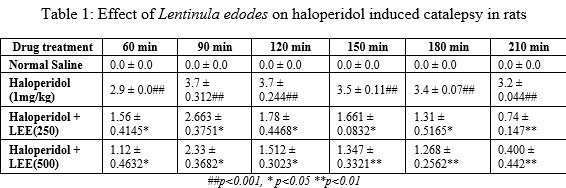
Result: The results of the analysis reveal that Lentinula edodes possesses significant neuroprotective activity in rodents. when compared with the saline-treated group. The haloperidol induced catalepsy and vacuous chewing movements were significantly decreased in treatment groups when compared with the saline group.
Conclusion: The findings of our investigation clearly indicate that Lentinula edodes possesses significant ameliorative effect on haloperidol induced catalepsy and vacuous chewing movements in the rats. This observed effect may be attributed to the rich phytochemical composition of the mushroom. Lentinula edodes, have strong antioxidant qualities because of their high phenolic content, flavonoids, and polysaccharides.
Downloads
References
Ejaz U, Afzal M, Naveed M, Amin ZS, Atta A, Aziz T, Kainat G, Mehmood N, Alharbi M, Alasmari AF. Pharmacological evaluation and phytochemical profiling of butanol extract of L. edodes with in- silico virtual screening. Sci Rep. 2024 Mar 8;14(1):5751.
Wasser SP. Medicinal properties and clinical effects of medicinal mushrooms. In: Wasser SP, editor. Edible and Medicinal Mushrooms: Technology and Applications. Wiley Online Library; 2017.
Huang Q, Qian J, Jiang T, Zheng X. Bioactive compounds and pharmacological properties of Lentinula edodes: A review. Food Sci Nutr. 2019;7(5):1–10.
Ziaja-Sońtys M, et al. Antitumor activity of Lentinula edodes extracts. Int J Mol Sci. 2020;21(1):1–12.
Hatvani N. Antibacterial effects of the culture fluid of Lentinula edodes. Int J Antimicrob Agents. 2001;17(1):71–74.
Jiang T, Luo S, Ying T. Antioxidant activities of extracts from Lentinula edodes. Food Chem. 2015;188:1–7.
Han X, et al. Anti-inflammatory effects of Lentinula edodes polysaccharides. Int J Biol Macromol. 2017;101:1–8.
Song Y, Ren Y, Wang X, Jia L, Zhang X. Reno protective effects of Lentinula edodes in experimental models. Biomed Pharmacother. 2020;121:109–115.
Nagashima Y, et al. Immunomodulatory activity of Lentinula edodes extracts. J Funct Foods. 2017;35:1–8.
Hu Y, et al. Nutritional composition and bioactive compounds of Lentinula edodes. Food Chem. 2020;306:125–132.
Morales D, et al. Nutritional and health properties of mushrooms: A review. Food Chem. 2019;276:1–13.
Xu X, Yan H, Tang J, Chen J, Zhang X. Polysaccharides in Lentinula edodes: Structure and bioactivity. Carbohydr Polym. 2014;99:1–10.
Gaitán-Hernández R, López-Peña D, Esqueda M, Gutiérrez A. Review of nutritional and medicinal properties of Lentinula edodes. Rev Mex Mycol. 2019;49:1–15.
Xu X, Yan H, Chen J, Zhang X. Bioactive proteins from mushrooms: A review on their isolation, purification and biological activities. Food Chem. 2011;128(3):612–620.
Jiang T, Luo S, Ying T. Antioxidant and antimicrobial activities of polysaccharides from Lentinula edodes. Food Chem. 2015;188:1–7.
Bhangale J O, Acharya S R. Anti-Parkinson activity of petroleum ether extract of Ficus religiosa (L.) leaves. Advances in Pharmacological Sciences, 2016.
Nade V S, Kawale L A, Zambre S, Kapure A B. Neuroprotective potential of Beta vulgaris L. in Parkinson's disease. Indian Journal of Pharmacology, 47(4):403-408, 2015.
Turrone P, Remington G, Kapur S, Nobrega J N. Differential effects of within-day continuous vs transient dopamine D 2 receptor occupancy in the development of vacuous chewing movements (VCMs) in rats. Neuropsychopharmacology, 28(8):1433-1439, 2003.
Salamone J D, Mayorga A J, Trevitt J T, Cousins M S, Conlan A, Nawab A. Tremulous jaw movements in rats: a model of parkinsonian tremor. Progress in Neurobiology, 56(6):591-611, 1998.
Downloads
Published
License
Copyright (c) 2025 Muhammad Aslam, Hammad Ahmed (Author)

This work is licensed under a Creative Commons Attribution 4.0 International License.
How to Cite