ANTIHYPERTENSIVE EFFECT OF HERBAL FORMULATION: WITH POSSIBLE MECHANISM OF ACTION.
DOI:
https://doi.org/10.71146/kjmr775Keywords:
Garlina, Antihypertensive, muscarinic receptors, β- adrenergic pathways, L NAMEAbstract
INTRODUCTION: This research work was done to evaluate the in vivo hypotensive and antihypertensive potential of polyherbal product Garlina and determine its receptor activity. Garlina was evaluated for lowering blood pressure in anaesthetized Wistar rats by using BP transducer coupled with Power Lab data acquisition system.
METHODOLGY: Intravenous administration of Garlina produced hypotensive effect in dose-dependent manner (29- 61.1) % fall in MABP at the log doses of 1, 3, 5, 10 and 30 mg/kg in normotensive rats.
RESULTS: The hypotensive effect of Garlina (10mg/kg) was abolished when rats pretreated with atropine sulfate. The same dose of Garlina did not eliminate the hypertensive effect of Phenylephrine (10-4 M) but it caused significant fall in MABP when given prior to adrenaline (Adr, 1µg/kg). These data showed that Garlina possess blood pressure lowering activity mediated via muscarinic receptors as well as β- adrenergic pathways.
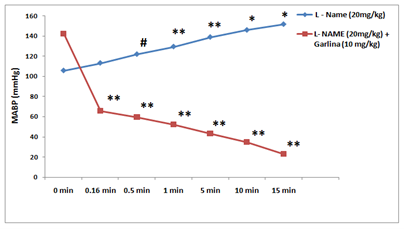
CONCLUSION: Following the L- NAME administration, Garlina gradually dropped the MABP in 15 minutes. The obtained results indicate that the possible mechanism of action is NO synthesis and NO-cGMP pathway behind the antihypertensive and vasorelaxant effect of Garlina. Therefore it is concluded that provides a rationale to the medicinal use in hypertension.
Downloads
Downloads
Published
License
Copyright (c) 2025 Dr. Farzana Sadaf , Dr. Sarah Jameel Khan, Ms. Hina Ilyas, Prof. Dr. Sumbul Shamim (Author)

This work is licensed under a Creative Commons Attribution 4.0 International License.
How to Cite