INVESTIGATING E-LEARNING SYSTEM EFFECTIVENESS IN PAKISTAN: EVIDENCE FROM AN EXTENDED DELONE AND MCLEAN MODEL
DOI:
https://doi.org/10.71146/kjmr773Keywords:
e-learning, e-learning in Pakistan, effectiveness of e-learning, DeLone and McLean Model, user satisfaction of e-learningAbstract
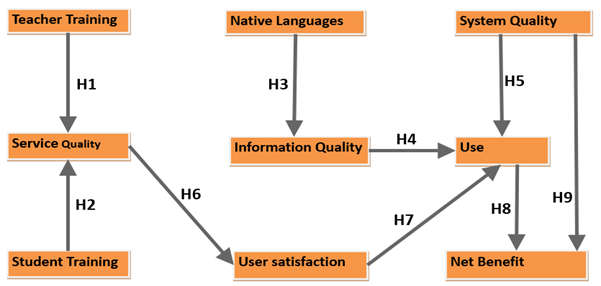
This paper employed a quantitative cross-sectional methodology to examine the factors influencing the effectiveness of e-learning systems in Pakistan. The study adopted a survey research design to collect responses from students, teachers, and ICT support staff in urban areas of the Sindh region, Pakistan. An extended DeLone and McLean Information Systems Success Model with additional student training, teacher training, and native language construct guided the study in data collection and analysis. The regression analysis confirmed the positive impacts of student training and teacher training variables on service quality variable, native language construct on information quality variable, information quality, and system quality variables on the dependent variable system use, service quality variable on user satisfaction variable, user satisfaction variable on system use, and system use variable on the dependent variable net benefits. However, the impact of system quality on net benefits failed to be confirmed. The study recommended the capacity-building training for teachers and students, incorporating native languages into e-learning, improving e-learning system operational qualities, technical and real-time support for users, and enhancing user engagement.to enhance the overall user experiences and satisfaction, and the effectiveness of e-learning systems.
Downloads
Downloads
Published
Issue
Section
Categories
License
Copyright (c) 2025 Abdul Khalique, Abdul Jaleel Mahesar, Moomal Havi, Syeda Hira Fatima Naqvi, Jamil Ahmed (Author)

This work is licensed under a Creative Commons Attribution 4.0 International License.
How to Cite